Exam AZ-305: Designing Microsoft Azure Infrastructure Solutions
Candidates for this exam should have advanced experience and knowledge of IT operations, including networking, virtualization, identity, security, business continuity, disaster recovery, data platforms, and governance. A professional in this role should manage how decisions in each area affect an overall solution. In addition, they should have experience in Azure administration, Azure development, and DevOps processes.
Passing score: 700. Learn more about exam scores.
- Download the AZ-305 study guide to help you prepare for the exam
- Watch AZ-305 Exam Prep videos on Learn
- Demo the exam experience by visiting our Exam Sandbox
Part of the requirements for: Microsoft Certified: Azure Solutions Architect Expert
The service of TestBraindump
Update Our Company checks the update every day. If you've bought AZ-305 test braindump from us, once there is the latest AZ-305 - Designing Microsoft Azure Infrastructure Solutions exam version, our system will send it to your e-mail automatically and immediately. And you can free update the Microsoft AZ-305 braindump study materials one-year if you purchase.
Refund We promise to you full refund if you failed the exam with AZ-305 test braindump. Within 7 days after exam transcripts come out, then scanning the transcripts, add it to the emails as attachments and sent to us. After confirmation, we will refund immediately.
Discount We will offer you different discount for you if you became a member of us.
Payment Our payment is by Credit Card. But it can be bound with the credit card, so the credit card is also available.
After purchase, Instant Download: Upon successful payment, Our systems will automatically send the product you have purchased to your mailbox by email. (If not received within 12 hours, please contact us. Note: don't forget to check your spam.)
The Microsoft AZ-305 also known as Designing Microsoft Azure Infrastructure Solutions is intended for experienced candidates with developed skills and a comprehensive knowledge of IT operations, which include networking, secure, visualization, disaster recovery, identity, business continuity, and governance. The candidates should be able to take a decision and assess the consequences, as well as consider how it affects the common decision. They also should be experienced in Azure development and administration, as well as in DevOps processes. What you need to know more is that this test along with the Microsoft Certified: Azure Administrator Associate certification leads to the Microsoft Certified: Azure Solutions Architect Expert accreditation. The second variant you can choose is to pass exam AZ-303 (retires in March, 2022) together with the AZ-305 test.
How can you stand out from thousands of candidates? How can you make your employer think highly of you? How can you qualify for the promotion? Passing AZ-305 test exam will make these dreams come true. As an important test of Microsoft, AZ-305 test exam become popular among people. The considerable salary and decent work and different kind benefits, the chance of training, all these stuff attract to you. Passing AZ-305 braindump actual test is a new start for you. But it is a tough task. You have to sacrifice your rest time to practice the AZ-305 test questions and learn AZ-305 braindump study materials. And the worst result is that you maybe fail the exam, it will be a great loss of time and money for you. In case this terrible thing happens, TestBraindump will be your best partner to help you pass AZ-305 test exam.
Skills measured
- Download the study guide in the preceding “Tip” box for more details about the skills measured on this exam.
- Design identity, governance, and monitoring solutions (25-30%)
- Design data storage solutions (25-30%)
- Design infrastructure solutions (25-30%)
- Design business continuity solutions (10-15%)
Reference: https://docs.microsoft.com/en-us/learn/certifications/exams/az-305
Microsoft AZ-305 Exam Syllabus Topics:
| Topic | Details |
|---|---|
Design Identity, Governance, and Monitoring Solutions (25-30%) | |
| Design a solution for logging and monitoring | - design a log routing solution - recommend an appropriate level of logging - recommend monitoring tools for a solution |
| Design authentication and authorization solutions | - recommend a solution for securing resources with role-based access control - recommend an identity management solution - recommend a solution for securing identities |
| Design governance | - recommend an organizational and hierarchical structure for Azure resources - recommend a solution for enforcing and auditing compliance |
| Design identities and access for applications | - recommend solutions to allow applications to access Azure resources - recommend a solution that securely stores passwords and secrets - recommend a solution for integrating applications into Azure Active Directory (Azure AD) - recommend a user consent solution for applications |
Design Data Storage Solutions (25-30%) | |
| Design a data storage solution for relational data | - recommend database service tier sizing - recommend a solution for database scalability - recommend a solution for encrypting data at rest, data in transmission, and data in use |
| Design data integration | - recommend a solution for data integration - recommend a solution for data analysis |
| Recommend a data storage solution | - recommend a solution for storing relational data - recommend a solution for storing semi-structured data - recommend a solution for storing non-relational data |
| Design a data storage solution for non-relational data | - recommend access control solutions to data storage - recommend a data storage solution to balance features, performance, and cost - design a data solution for protection and durability |
Design Business Continuity Solutions (10-15%) | |
| Design a solution for backup and disaster recovery | - recommend a recovery solution for Azure, hybrid, and on-premises workloads that meets recovery objectives (Recovery Time Objective [RTO], Recovery Level Objective [RLO], Recovery Point Objective [RPO]) - understand the recovery solutions for containers - recommend a backup and recovery solution for compute - recommend a backup and recovery solution for databases - recommend a backup and recovery solution for unstructured data |
| Design for high availability | - identify the availability requirements of Azure resources - recommend a high availability solution for compute - recommend a high availability solution for non-relational data storage - recommend a high availability solution for relational data storage |
Design Infrastructure Solutions (25-30%) | |
| Design a compute solution | - recommend a virtual machine-based compute solution - recommend an appropriately sized compute solution based on workload requirements - recommend a container-based compute solution - recommend a serverless-based compute solution |
| Design an application architecture | - recommend a caching solution for applications - recommend a messaging architecture - recommend an event-driven architecture - recommend an automated deployment solution for your applications - recommend an application configuration management solution - recommend a solution for API integration |
| Design migrations | - evaluate a migration solution that leverages the Cloud Adoption Framework for Azure - assess and interpret on-premises servers, data, and applications for migration - recommend a solution for migrating applications and virtual machines - recommend a solution for migrating databases - recommend a solution for migrating unstructured data |
| Design network solutions | - recommend a network architecture solution based on workload requirements - recommend a connectivity solution that connects Azure resources to the internet - recommend a connectivity solution that connects Azure resources to on-premises networks - optimize network performance for applications - recommend a solution to optimize network security - recommend a load balancing and routing solution |
Different versions according to your study habits
The version of Pdf is suitable to most common people because it can be print out and is easy to read. And you can share with other people about AZ-305 test braindump anytime.
The version of test engine is a simulation of the AZ-305 braindump actual test, you can feel the atmosphere of Microsoft AZ-305 test exam and get used to the condition of the real test in advance. It only can support the Windows operating system. In the course of AZ-305 test exam, you will know your shortcoming and strength well.
The version of online test engine just same like test engine. But it can download AZ-305 test braindump study materials in any electronic equipment, such as: Windows/Mac/Android/iOS operating systems. The online version is only service you can enjoy from our TestBraindump. The most advantage of online version is that you can practice AZ-305 test questions anytime and anywhere even if you are unable to access to the internet. So you can do AZ-305 real braindump in the bus or waiting someone. You can learn anywhere.
The latest Microsoft AZ-305 test braindump guarantee a high score
TestBraindump provide you with AZ-305 braindump latest and AZ-305 test questions, which are created by our extraordinary teammates who study the AZ-305 braindump actual test for a long time. And we always check the update of the AZ-305 test braindump, the system will send you the latest version of Microsoft AZ-305 real braindump once there is latest version released. So you can trust us about the profession and accuracy of our AZ-305 test braindump. If you still doubt our ability, you can download the free trial of AZ-305 braindump Designing Microsoft Azure Infrastructure Solutions study materials before you buy. If you decide to join us, you just need to send one or two days to practice AZ-305 test questions and remember the key knowledge of the test. I think if you practice our AZ-305 test braindump skillfully, you will pass the test easily.

Microsoft Designing Microsoft Azure Infrastructure Solutions Sample Questions:
You have the resources shown in the following table.
You create a new resource group in Azure named RG2.
You need to move the virtual machines to RG2.
What should you use to move each virtual machine? To answer, select the appropriate options in the answer area.
NOTE: Each correct selection is worth one point.
Correct Answer:

Explanation:
VM1: Azure Resource Mover; VM2: Azure Migrate
Resource Mover handles an existing Azure VM's move between regions. Azure Migrate handles an on- premises VM migration to Azure
Your company deploys several Linux and Windows virtual machines (VMs) to Azure. The VMs are deployed with the Microsoft Dependency Agent and the Log Analytics Agent installed by using Azure VM extensions.
On-premises connectivity has been enabled by using Azure ExpressRoute.
You need to design a solution to monitor the VMs.
Which Azure monitoring services should you use? To answer, select the appropriate Azure monitoring services in the answer area.
NOTE: Each correct selection is worth one point.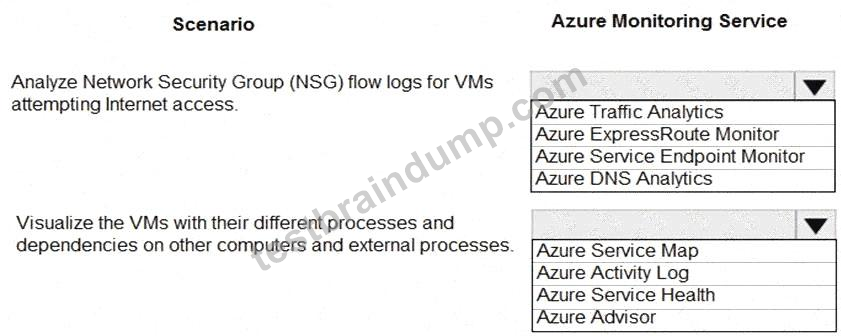
Correct Answer:

Explanation:
Box 1: Azure Traffic Analytics
Traffic Analytics is a cloud-based solution that provides visibility into user and application activity in cloud networks. Traffic analytics analyzes Network Watcher network security group (NSG) flow logs to provide insights into traffic flow in your Azure cloud. With traffic analytics, you can:
Identify security threats to, and secure your network, with information such as open-ports, applications attempting internet access, and virtual machines (VM) connecting to rogue networks.
Visualize network activity across your Azure subscriptions and identify hot spots.
Understand traffic flow patterns across Azure regions and the internet to optimize your network deployment for performance and capacity.
Pinpoint network misconfigurations leading to failed connections in your network.
Box 2: Azure Service Map
Service Map automatically discovers application components on Windows and Linux systems and maps the communication between services. With Service Map, you can view your servers in the way that you think of them: as interconnected systems that deliver critical services. Service Map shows connections between servers, processes, inbound and outbound connection latency, and ports across any TCP-connected architecture, with no configuration required other than the installation of an agent.
References:
https://docs.microsoft.com/en-us/azure/network-watcher/traffic-analytics
https://docs.microsoft.com/en-us/azure/azure-monitor/insights/service-map
Your company has 50 business units across the globe. The business units operate from 08:00 AM to 06:00 PM from Monday to Friday in their local time zone. Transactions are only processed during business hours.
You have an Azure subscription.
You plan to deploy an app named App1 that will manage the transactions for the business units. App1 will use a separate Azure SQL database for each business unit.
You need to recommend an Azure SQL Database configuration for App1. The solution must meet the following requirements:
* Support Azure Hybrid Benefit licensing.
* Minimize costs.
What should you recommend?
- A. a vCore purchasing model and multiple database instances in an elastic pool
- B. a DTU purchasing model and multiple database instances in an elastic pool
- C. a DTU purchasing model and multiple single database instances
- D. a vCore purchasing model and multiple single database instances
Correct Answer: A 🗳️
You are planning an Azure Storage solution for sensitive data. The data will be accessed daily. The data set is less than 10 GB.
You need to recommend a storage solution that meets the following requirements:
* All the data written to storage must be retained for five years.
* Once the data is written, the data can only be read. Modifications and deletion must be prevented.
* After five years, the data can be deleted, but never modified.
* Data access charges must be minimized
What should you recommend? To answer, select the appropriate options in the answer area.
NOTE: Each correct selection is worth one point.
Correct Answer:

Explanation:
GPv2 Hot tier; container immutability/time-based retention policy
Daily access makes Hot the appropriate tier. A five-year immutable retention policy provides WORM protection; an ARM resource lock does not prevent blob data-plane modification.
You have an Azure subscription that contains the resources shown in the following table.
Log files from App1 are ingested to App 1 Logs. An average of 120 GB of log data is ingested per day.
You configure an Azure Monitor alert that will be triggered if the App1 logs contain error messages.
You need to minimize the Log Analytics costs associated with App1. The solution must meet the following requirements:
* Ensure that all the log files from App1 are ingested to App 1 Logs.
* Minimize the impact on the Azure Monitor alert.
Which resource should you modify, and which modification should you perform? To answer, select the appropriate options in the answer area.
NOTE: Each correct selection is worth one point.
Correct Answer:

Explanation:
Viewing page 1 out of 75 pages.
Viewing questions 1-5 out of 374 questions.
 Hilary

 Avery

 Spring
 Hardy
 Lucy
 Mick

 Rodney
 Amos
 Mick
 Hermosa
 Craig
 Tyler
 Philip
 Fanny
 Grover
 Nancy
 Sidney
 Ernest
 King
 Lyndon