
[2026] Get Top-Rated ServiceNow CIS-DF Exam Dumps Now
Passing Key To Getting CIS-DF Certified Exam Engine PDF
NEW QUESTION # 36
A CMDB Configuration Manager is reviewing the metrics on the CMDB Health Dashboard -- Correctness Scorecard for the Server class, which consists of 60,000 servers in the CMDB.
For the Duplicate metric, it shows Healthy CIs / Evaluated = 59,000 / 60,000 For the Orphan metric, it shows Healthy CIs / Evaluated = 45,000 / 50,000 Which configuration explains the difference in the scope of Server CIs evaluated (60,000 vs
50,000) between the two metrics?
- A. The Duplicate metric has a CMDB Group configured for the Server class
- B. The Orphan metric has a CMDB Group configured for the Server class
- C. The Duplicate metric has a Health Inclusion rule configured for the Server class
- D. The Orphan metric has a Health Inclusion rule configured for the Server class
Answer: D
Explanation:
In ServiceNow, each CMDB Health metric can independently define which CIs are in scope for evaluation. This scoping is controlled primarily through Health Inclusion Rules, not CMDB Groups.
In this scenario, the Duplicate metric evaluates all 60,000 Server CIs, indicating no inclusion rule is restricting its scope. In contrast, the Orphan metric evaluates only 50,000 Server CIs, which means 10,000 servers are intentionally excluded from that metric's evaluation.
This difference is explained by a Health Inclusion rule configured specifically for the Orphan metric on the Server class. Health Inclusion rules allow administrators to define conditions--such as lifecycle state, environment, discovery source, or operational status--that determine whether a CI should be included in a specific health calculation. For example, retired servers or servers in build states may be excluded from orphan checks.
CMDB Groups are not used by the CMDB Health Engine to determine metric scope; they are used for reporting, assignment, and operational grouping. Therefore, Options A and D are incorrect. Option C is also incorrect because the Duplicate metric clearly evaluates the full population of 60,000 servers.
NEW QUESTION # 37
A CMDB Administrator needs to set up CMDB 360/Multisource CMDB Drag and drop the system propertyto the functionality Some options may not apply.
Answer:
Explanation: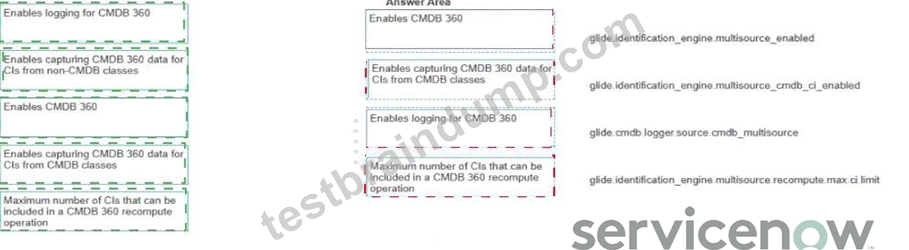
Explanation: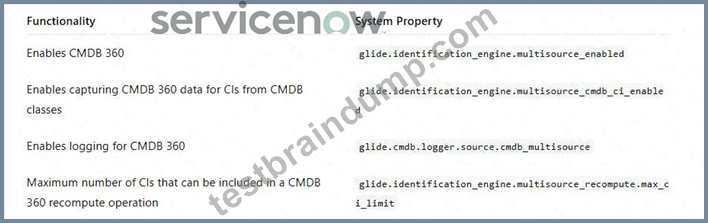
InServiceNow,CMDB 360 / Multisource CMDBextends the Identification and Reconciliation Engine (IRE) to supportmulti-source visibility, reconciliation, and confidence scoring. Configuration is controlled throughsystem properties, each enabling a specific capability.
glide.identification_engine.multisource_enabledis the master switch that activates CMDB 360 functionality.
glide.identification_engine.multisource_cmdb_ci_enabledallows CMDB 360 to collect and evaluate data specifically fromCMDB CI classes.
glide.cmdb.logger.source.cmdb_multisourceenables detailed logging for troubleshooting multisource ingestion and reconciliation.
glide.identification_engine.multisource_recompute.max_ci_limitprotects performance by limiting how many CIs can be processed during a recompute operation.
Capturing CMDB 360 data fromnon-CMDB classesisnot supported, which is why no property applies to that option.
This mapping aligns withData Foundations and CMDB governance best practices, ensuring CMDB 360 is enabled safely, transparently, and at scale.
NEW QUESTION # 38
Where can an administrator perform Natural Language Queries (NLQ)?
- A. CI Class Manager
- B. CMDB Health Dashboard
- C. CMDB Workspace
- D. CMDB Data Manager
Answer: C
Explanation:
In Data Foundations, the "Insight" topic is about making CMDB and service data easy to discover, understand, and use for operational decisions. Natural Language Queries (NLQ) support this by enabling admins and practitioners to ask questions in plain language (for example, finding specific CIs, services, or relationships) and quickly retrieve relevant results without navigating multiple tables and filters.
NLQ is performed in CMDB Workspace because CMDB Workspace is the primary user experience for exploring configuration data, visualizing relationships, and consuming insights from the CMDB in a guided way. It is designed as the central hub where CMDB users validate CI information, examine dependencies, and use workspace capabilities to troubleshoot and analyze.
NLQ fits naturally here: it accelerates discovery and analysis by reducing the need for advanced query building and manual report construction.
NEW QUESTION # 39
A CMDB Administrator wants to remove allLinux Serversin the organization that havenot been updated in six months.
Whichrecommended actionshould the Administrator take in Data Foundations?
- A. Create an archive policy
- B. Create a business rule
- C. Create a scheduled job
Answer: A
Explanation:
Removing obsolete or inactive CIs from the CMDB must be handled carefully to avoid data loss, audit issues, and unintended operational impact. InServiceNow, the recommended and governed approach is to use anarchive policy.
Archive policiesare designed to manageCI lifecycle cleanupbased on defined conditions such as class, last updated date, lifecycle status, or operational state. In this scenario, the condition would targetLinux Server CIsthat have not been updated in six months. Archive policies can either archive or permanently delete records in a controlled, auditable manner, ensuring compliance with data retention and governance standards.
Creating abusiness rule(Option A) is strongly discouraged for bulk CMDB cleanup because it introduces technical debt, upgrade risk, and unpredictable side effects. Ascheduled job(Option C) may automate execution but lacks governance logic and lifecycle awareness on its own.
Archive policies integrate withCMDB Data Manager, provide visibility into actions taken, and support approval and rollback where appropriate. This aligns fully with Data Foundations best practices for maintaining alean, accurate, and trusted CMDB.
Therefore, the correct and recommended action isB - Create an archive policy.
NEW QUESTION # 40
ACMDB Administrator seeks to understand the available tools for preventing addressing, and remediating duplicate CIs Drag and drop each feature with the corresponding outcome Some options may not apply.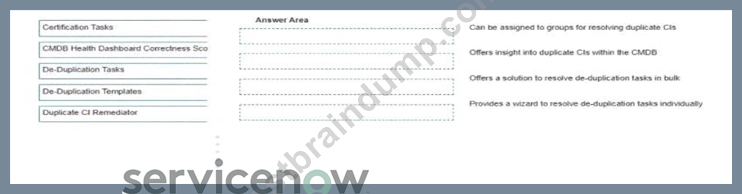
Answer:
Explanation: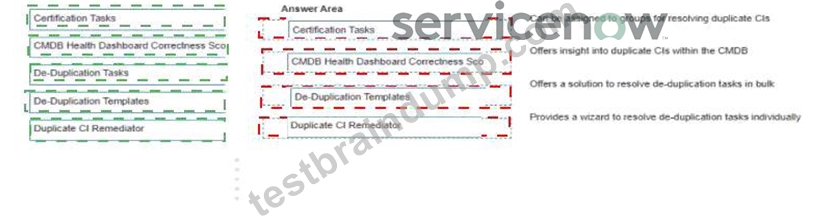
Explanation:
InServiceNow, duplicate CI management spansdetection, insight, and remediation:
TheCMDB Health Dashboard - Correctnesssurfaceswhere duplicates existand their impact, providing visibility and prioritization.
Certification Taskssupportgoverned resolution, allowing assignment to individuals or groups to validate and correct data.
De-duplication Templatesenablebulk remediation, ideal when standardized merge rules can be applied across many duplicates.
TheDuplicate CI Remediatoroffers aguided, record-by-record wizard, preserving relationships and history for safer individual resolutions.
De-duplication Tasksare the work items generated by these processes, but they do not themselves represent an outcome-hencenot applicable.
This mapping aligns withCMDB Data Foundations best practices, ensuring duplicates are identified, prioritized, and remediated efficiently and safely.
NEW QUESTION # 41
A Data Center Manager is working with the CMDB CI Class Manager to define the relationship between Application Servers and the Applications they host. The company has multiple Application Servers that host one or more Applications.
Which describes the relationship between the Application Server table and the Application table?
- A. Many-to-many
- B. Many-to-one
- C. One-to-one
- D. One-to-many
Answer: A
Explanation:
In CMDB modeling, accurately defining relationships is critical for impact analysis, service mapping, and Change Management. In this scenario, Application Servers can host multiple Applications, and Applications can also run across multiple Application Servers (for example, in clustered, load- balanced, or distributed architectures).
This architectural reality defines a many-to-many relationship between the Application Server table and the Application table.
In ServiceNow, many-to-many relationships are common for application hosting models, especially in modern environments that use horizontal scaling, redundancy, or containerized workloads. Modeling this correctly ensures that incidents, changes, and outages affecting a single server can be accurately traced to all impacted applications--and vice versa.
A one-to-many or many-to-one relationship would incorrectly assume exclusivity in one direction, which does not reflect real-world application deployment patterns. A one-to-one relationship would be even more restrictive and inaccurate.
NEW QUESTION # 42
A Configuration Manager is planning the implementation of the CMDB.
Which is the prescribed CSDM rollout order?
- A. Architecture, Business, Technical, Governance
- B. Crawl, Walk, Run, Fly
- C. Initiate, Plan, Execute, Deliver, Close
- D. Initial, Developing, Defined, Managed
Answer: B
Explanation:
The Common Service Data Model (CSDM) prescribes an incremental, maturity-based rollout approach to reduce risk and ensure sustainable adoption. The recommended order is Crawl, Walk, Run, Fly, which aligns implementation effort with increasing organizational capability and value realization.
Crawl focuses on foundational data hygiene: core CI classes, identification rules, reconciliation, basic Discovery ingestion, and CMDB Health basics.
Walk introduces service context, including Business Services, Application Services, and relationships that enable impact analysis for Incident and Change.
Run expands into operational excellence with Service Mapping, service offerings, advanced governance, and process automation.
Fly represents optimization and scale, leveraging analytics, AI/ML, proactive operations, and cross- domain integration (e.g., SecOps, APM, CSM).
This progression ensures teams do not over-model early or introduce complexity before data quality and governance are established. The other options describe generic project lifecycles or organizational categorizations, not the CSDM-recommended adoption path.
NEW QUESTION # 43
A manufacturing organization has implemented Incident Management in ServiceNow and wants to integrate additional products to enhance its functionality.
Drag each ServiceNow product to the value it brings in supporting Incident Management.
Answer:
Explanation:
Explanation:
Enhancing Incident Management inServiceNowoften involves integrating complementary products that enrichcontext, prioritization, and decision-making.
Discoverystrengthens incident resolution by automatically populating accurate CI data and relationships, allowing responders to quickly understand affected infrastructure and applications.
Hardware Asset Management (HAM)adds visibility into asset lifecycle, ownership, and maintenance actions, which is especially valuable when incidents involve physical devices or failures.
Risk Management(part of IRM) provides insight intobusiness and financial risk exposure, helping teams prioritize incidents based on potential regulatory, safety, or financial impact.
Service Portfolio Management (SPM)connects incidents to theservice lifecycle, enabling better understanding of whether an incident affects a live, retiring, or planned service-and improving communication with stakeholders.
Together, these integrations transform Incident Management from a reactive process into acontext-rich, business-aligned capability.
NEW QUESTION # 44
The CMDB Administrator has set up two Dynamic Reconciliation Rules within the ServiceNow Production Instance. The 'Server' class has a Dynamic Reconciliation Rule of largest value for the RAM field. The 'Windows Server' class has a Dynamic Reconciliation Rule of most reported for the RAM field.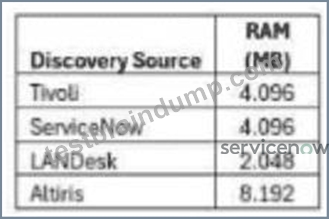
Given the above data inMultisource CMDB, which value is added to the CMDB forRAMfor aServer CI?
- A. 2,048 MB
- B. 8,192 MB
- C. 4,096 MB
Answer: B
Explanation:
This question hinges on understandingclass-specific Dynamic Reconciliation RulesinCMDB 360 / Multisource CMDBwithinServiceNow.
Although two different dynamic rules are configured,the rule applied depends on the CI class being evaluated:
For theServerclass, the configured rule isLargest valuefor the RAM attribute.
For theWindows Serverclass, the ruleMost reportedwould apply-butonly if the CI were evaluated as a Windows Server.
The question explicitly asks for the resulting RAM value for aServer CI, not a Windows Server CI. Therefore, theLargest valuerule governs the outcome.
Looking at the multisource values:
2,048 MB (LANDesk)
4,096 MB (Tivoli)
4,096 MB (ServiceNow)
8,192 MB (Altiris)
Under theLargest valuedynamic reconciliation rule, the IRE selects themaximum numeric value, regardless of how frequently it is reported or which source provided it.
TheMost reportedlogic (which would result in 4,096 MB) doesnot applyhere because that rule is configured for a different class (Windows Server).
This scenario illustrates an important CMDB 360 principle:Dynamic reconciliation is evaluated per class, and child-class rules do not override parent-class rules unless the CI is actually classified under that child class.
NEW QUESTION # 45
Where can a CMDB 360 / Multisource CMDB Saved Query be viewed and created in the CMDB Workspace?
- A. CMDB Query Builder
- B. Saved queries window on the CMDB 360 tab
- C. Coverage window on the CMDB 360 tab
- D. Saved queries window on the Insights tab
Answer: B
Explanation:
In Data Foundations, "Insight" focuses on turning configuration data into actionable visibility. CMDB 360 (often associated with Multisource CMDB capabilities) provides a guided experience in CMDB Workspace for exploring CI data and running queries across sources. Within this experience, Saved Queries are managed directly under the CMDB 360 area of CMDB Workspace because they are part of the CMDB 360 query-and- analysis workflow.
A CMDB 360 Saved Query is not the same as a generic CMDB Query Builder query created from classic navigation modules. The CMDB 360 experience typically uses a tile/window approach where users can view existing saved queries, create new queries, modify them, and run them to retrieve CMDB 360 data aligned to multisource reporting and analysis. Keeping saved queries on the CMDB 360 tab makes them easy to discover and reuse for repeatable insights (for example, coverage and source comparisons, CI data quality checks by source, and targeted investigation of records).
The Insights tab in CMDB Workspace is generally used to understand adoption and health-related insights about CMDB features, not as the primary location for creating CMDB 360 multisource saved queries.
"Coverage" is a specific lens/view and does not represent the saved-query creation workspace. "CMDB Query Builder" is a related capability, but the question explicitly asks where CMDB 360/Multisource Saved Queries are viewed and created in CMDB Workspace, which is the Saved queries window on the CMDB 360 tab.
NEW QUESTION # 46
The following identification rule for a Hardware CI class has been defined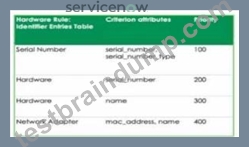
Two new CI records are imported into the Hardware class of the CMDB:
CI1: The name of this CI record matches the name of an existing CI record in the CMDB.
CI2: The IP address of this CI record matches the IP address of an existing CI record in the CMDB.
Which is correct based on the identification rule and the imported CI records?
- A. CI1 will be inserted as a new record and CI2 will be updated with the matching record
- B. CI1 and CI2 both will be updated with matching records
- C. CI1 will be updated with the matching record and CI2 will be inserted as a new record
- D. CI1 and CI2 both will be inserted as new records
Answer: D
Explanation:
This question tests understanding of how the Identification and Reconciliation Engine (IRE) evaluates incoming CI data against Identification Rules and their priority order in ServiceNow.
From the identification rule shown:
Serial number (+ type) # Priority 100
Serial number # Priority 200
Name (Hardware) # Priority 300
MAC address + name (Network Adapter) # Priority 400
For a CI to be identified and matched, the incoming record must satisfy one complete identifier entry exactly as defined for that class.
CI1 (Name match only)
Although the name matches an existing Hardware CI, name alone is a low-priority identifier (300) and is not sufficient to uniquely identify a Hardware CI unless no higher-priority identifiers exist and the identifier entry criteria are fully satisfied. In practice, Hardware identification relies on serial number-based identifiers, not name-only matching, to avoid false positives. Therefore, CI1 cannot be confidently matched and is inserted as a new record.
CI2 (IP address match)
IP address is not part of any Hardware identification rule shown. IP address is typically used for discovery correlation or network relationships, not as a primary Hardware identifier. Since no identifier entry includes IP address, CI2 does not match any valid identification rule and is also inserted as a new record.
Because neither CI satisfies a valid identifier entry, both records are inserted as new CIs.
NEW QUESTION # 47
A Configuration Management Process Owner is preparing solution options for presentation to the technical governance board for ingesting custom CIs to the CMDB. The solution needs to align with best practice, minimize the cost of future work (technical debt), and ensure compliance with future upgrades.
Which solutions accomplish this? (Choose two.)
- A. Repurposing a base CI class and renaming attributes, as required
- B. Installing or upgrading the CMDB CI Class Models store application to find a suitable existing CI class accommodating any new attributes
- C. Extending an existing CI class table to accommodate the custom CI class attributes
- D. Extending an existing Asset class table to accommodate the custom CI class attributes
Answer: B,C
Explanation:
Data Foundations emphasizes that "ingest" must produce CMDB data that is standardized, supportable, and upgrade-safe. When introducing custom CIs, the best practice is to reuse the most appropriate existing CI class (or an approved industry-aligned model) and only add what is necessary-this keeps the data model aligned with platform expectations and reduces downstream rework.
Option B supports this directly: the CMDB CI Class Models application is intended to help teams select a suitable existing class rather than inventing new classes unnecessarily. Reusing existing classes improves consistency across integrations, Discovery/Service Mapping patterns, reporting, and CMDB Health rules- reducing technical debt and making future platform upgrades smoother.
Option A is also aligned with best practice when used correctly: once you have the right CI class, extending that class to add additional attributes (new fields) is a standard, upgrade-safe customization approach. It preserves the underlying platform data structures and avoids breaking out-of-box behaviors, identification
/reconciliation practices, and CMDB Health evaluations.
Option C is not appropriate because Asset tables serve a different purpose (financial/lifecycle tracking) than CI tables (operational/service context). Mixing CI attributes into Asset classes creates confusion and process misalignment. Option D is strongly discouraged because repurposing and renaming base attributes creates long-term ambiguity, breaks shared semantics, and increases upgrade and maintenance risk.
NEW QUESTION # 48
What is the relationship between an Application and a Server?
- A. Application > Used by::Uses > Server
- B. Application > Runs on::Runs > Server
- C. Application > Uses::Used by > Server
- D. Application > Runs::Runs On > Server
Answer: B
Explanation:
In Data Foundations (CMDB and CSDM), relationship modeling must reflect real operational dependency so that incident triage, change impact analysis, and service visibility remain accurate. When an Application is hosted on a Server, the standard hosting-style relationship used in CMDB relationship governance is expressed as "Runs on::Runs". This pairing represents the two directional descriptors of the same relationship type: from the application perspective it runs on the server, and from the server perspective it runs the application.
This matters because CMDB relationships are used by downstream capabilities (for example, dependency views, impact calculations, and governance rules). Using the correct out-of-box relationship descriptor pair ensures consistent reporting and prevents confusion when teams traverse relationships "upstream" and
"downstream." In addition, relationship governance rules and inheritance are commonly built around standard relationship types; using the correct "Runs on::Runs" semantics supports validation across subclasses (for example, specific application and server subclasses) without requiring custom relationship definitions.
The other options are either reversed ("Runs::Runs On"), represent different semantics ("Uses::Used by"), or do not align with the typical hosting relationship naming used for application-to-server hosting dependencies.
Therefore, the correct relationship expression between an Application and a Server is Application > Runs on::
Runs > Server.
NEW QUESTION # 49
Some steps need to be taken to transition from using legacy CMDB status attributes to CSDM lifecycle objects.
Drag and drop the objects / attributes to the correct descriptions.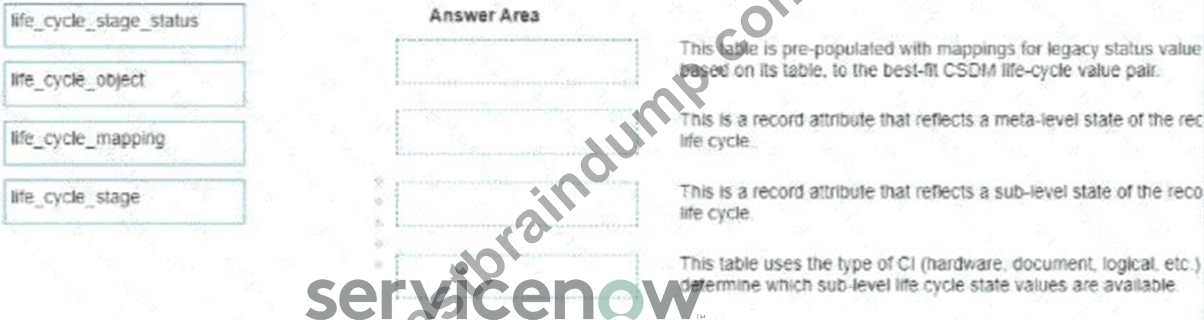
Answer:
Explanation: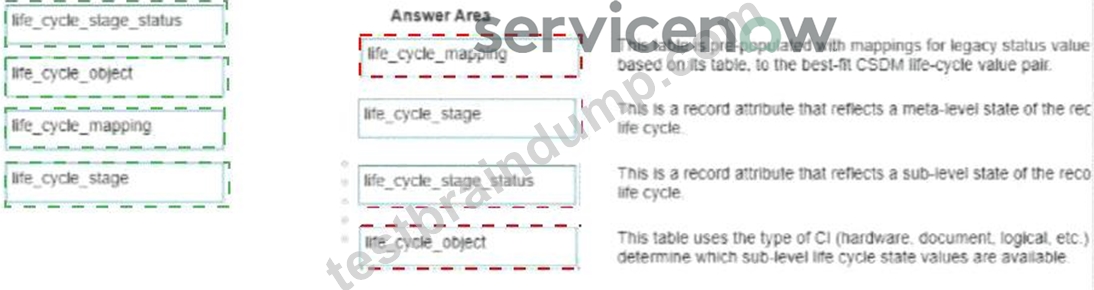
Explanation:
When transitioning to CSDM-aligned lifecycle management, ServiceNow introduces a structured lifecycle framework that separates high-level intent from detailed operational state.
Life Cycle Stage represents the macro phase of a CI's existence (for example: Plan, Build, Deploy, Operate, Retire).
Life Cycle Stage Status refines that phase with granular, sub-level states that vary by CI type.
Life Cycle Object determines which lifecycle stages and statuses apply, based on what kind of CI is being managed (hardware, application, document, etc.).
Life Cycle Mapping ensures a safe transition from legacy status fields by translating existing values into standardized CSDM lifecycle values-avoiding data loss or process disruption.
Together, these objects enable consistent lifecycle governance, improve reporting accuracy, and support automation across ITSM, ITOM, and IRM use cases-while remaining backward compatible with legacy CMDB data.
NEW QUESTION # 50
A Platform Owner is collaborating with stakeholders in the manufacturing industry to align their CIs with the CSDM 5 framework. They need to map production line monitoring systems to the appropriate CSDM domain.
Which CSDM 5 domain does the Platform Owner use?
- A. Service Delivery (Manage Technical)
- B. Foundation
- C. Design and Planning (Design)
- D. Service Consumption (Sell/Consume)
- E. Build and Integration (Build)
Answer: A
Explanation:
In CSDM 5, production line monitoring systems (such as SCADA, MES, IoT telemetry platforms, and operational monitoring tools) are technical systems responsible for operating, monitoring, and supporting services, not for designing them or consuming them. These systems directly align with the Service Delivery (Manage Technical) domain.
The Service Delivery domain is used to model how services are technically delivered and operated, including the infrastructure, platforms, and operational technologies that ensure availability, performance, and reliability. In a manufacturing context, production line monitoring systems continuously observe equipment health, throughput, alerts, and operational metrics-- making them part of the technical service delivery layer.
NEW QUESTION # 51
A CMDB Administrator identifies duplicate CIs. One was created by a manual import, and the other was created by automated discovery. The discovered CI has the latest IP address, while the manually imported CI has an accurate relationship to a critical business application.
How does the Administrator use the Duplicate CI Remediator to resolve this issue?
- A. Retain the manually imported CI and delete the discovered CI
- B. Merge the two CIs automatically, retaining all attributes from the discovered CI
- C. Retain the discovered CI and delete the manually imported CI
- D. Retain the discovered CI, but merge the relationship from the manually imported CI
Answer: D
Explanation:
In ServiceNow, the Duplicate CI Remediator is designed to resolve duplicate records while preserving the most authoritative data from each source. Data Foundations guidance clearly states that automated discovery is the system of record for technical attributes, such as IP address, hostname, and operational status, while manually maintained records often contain valuable business context, such as relationships to business applications or services.
In this scenario, the discovered CI contains the most accurate and up-to-date technical data, making it the correct CI to retain as the primary record. However, the manually imported CI has a critical relationship to a business application, which is essential for impact analysis, incident prioritization, and CSDM alignment. Deleting this CI without preserving the relationship would result in loss of business context and reduced CMDB value.
The Duplicate CI Remediator supports selective merging, allowing administrators to retain one CI while merging specific attributes or relationships from the duplicate. Option C reflects this best practice by retaining the discovered CI and merging the relationship from the manually imported CI, ensuring both technical accuracy and business relevance are preserved.
NEW QUESTION # 52
A CMDB Administrator wants to create a CMDB query to find all databases located in Seattle that are connected to application services. They also want to include incidents related to those databases.
Which actions should be taken to build this query? (Choose 2 options)
- A. Add to the canvas the Incident table from the Non-CMDB Tables list
- B. Set the relationship level to up to 2nd-level relationships
- C. Add property columns to the Application Service node
- D. Add a filter to the Database node for Location = Seattle
Answer: A,D
Explanation:
When building advanced CMDB queries using CMDB Query Builder in ServiceNow, the correct approach is to model CI scope, relationships, and task context explicitly on the canvas.
To limit results to databases in a specific location, the administrator must filter the Database CI node by the Location attribute. Therefore, Option C is required to scope the query to Database CIs where Location = Seattle.
To include Incidents related to those databases, the Incident table must be added from the Non- CMDB Tables list and linked through the task_ci relationship. This is exactly what Option A provides. CMDB Query Builder separates CMDB tables (CIs) from task and transactional tables, so incidents must be explicitly added from the Non-CMDB section.
NEW QUESTION # 53
A CMDB Administrator has installed aService Graph Connectorand customized ascript transform.
What will happen on subsequent upgrades if thedefault definition of the script transform is updated?
- A. The upgrade stops and reports an error
- B. A skipped change is created and no change is made to the script transform definition
- C. The Service Graph Connector upgrade refuses to start
Answer: B
Explanation:
InServiceNow, Service Graph Connectors deliver data ingestion patterns usingprotected, upgrade-safe artifacts, including script transforms. When a customercustomizesa script transform provided by a Service Graph Connector, ServiceNow follows standardupdate set and upgrade behaviorto protect customer customizations.
During a subsequent upgrade, if theout-of-box (default) script transform definition changes, ServiceNowdoes not overwrite the customized version. Instead, the platform records askipped change, indicating that an update was available but intentionally not applied due to a local customization. This ensures customer-specific logic is preserved while still maintaining transparency about what changed in the newer release.
Option A is incorrect because upgrades do not halt due to customized transforms. Option C is also incorrect because Service Graph Connector upgrades proceed normally; they do not refuse to start because of customizations.
This behavior aligns with Data Foundations best practices:avoid modifying OOTB content when possible, but when customization is necessary, ensure it is protected during upgrades. Administrators should review skipped changes after upgrades to decide whether to manually adopt new OOTB logic.
Therefore, the correct answer isB - A skipped change is created and no change is made to the script transform definition.
NEW QUESTION # 54
A CMDB Administrator is implementing Vulnerability Response or Security Incident Response and needs to ensure customers have enough context to estimate risk and set task priorities.
WhichGet Well Playbookfrom theCSDM Data Foundations Dashboardhelps with this?
- A. Percentage of Custom Status Values for CI Life Cycle Stages
- B. Named Product Models without Product Owners
- C. Locations without a Parent Location
- D. Application Services with Business Application Relationships
Answer: D
Explanation:
InServiceNow, Vulnerability Response and Security Incident Response rely heavily onbusiness contextto accurately assess risk, prioritize remediation tasks, and communicate impact to stakeholders. From aCSDM (Common Service Data Model)perspective, this context is primarily delivered throughproperly modeled relationships between Application Services and Business Applications.
The"Application Services with Business Application Relationships" Get Well Playbookdirectly addresses this requirement. In CSDM,Application Servicesrepresent the technical, deployable services that run in the environment, whileBusiness Applicationsrepresent the logical applications that support business capabilities.
When these two are correctly related, security teams can clearly understandwhich business processes, customers, and revenue streams are affectedby a vulnerability or security incident.
Without this relationship, vulnerabilities may still be detected, but they lack meaningful prioritization. For example, a critical vulnerability on an application service supporting a revenue-generating or customer-facing business application should be addressed far more urgently than one tied to a low-impact internal tool. This relationship is what enablesrisk-based prioritization, rather than purely technical severity-based prioritization.
The other options do not fulfill this need. Location hierarchy issues (Option A) and CI lifecycle status consistency (Option D) relate more to CMDB hygiene and governance, not security context. Product ownership gaps (Option C) affect accountability but do not directly enable risk estimation during security response.
Therefore,Option Bis the correct and CSDM-aligned Get Well Playbook for ensuring sufficient business context in Vulnerability Response and Security Incident Response workflows.
NEW QUESTION # 55
An organization is changing data centers and needs to know the consequences of the planned changes.
How can Application Service Mapping be used as part of Change Management?
- A. To understand the physical location of CIs
- B. To understand the business impact of CIs
- C. To identify which devices will go offline first
Answer: B
Explanation:
Application Service Mapping is a critical capability in ServiceNow for enabling business-aware Change Management. Its primary value is not in identifying physical shutdown sequences or CI locations, but in translating technical changes into business impact.
When an organization plans a data center move, multiple infrastructure components--servers, databases, network devices--may be affected. On their own, these technical CIs provide little insight into business risk. Application Service Mapping connects these CIs to Application Services and Business Services as defined by the Common Service Data Model (CSDM). This relationship allows Change Managers to see which business services, customers, and processes are impacted by the planned change.
NEW QUESTION # 56
A CMDB Administrator needs to import external data into the CMDB. To reduce the risk of creating duplicates and prevent updates from unauthorized sources, it must be ensured that the Identification and Reconciliation Engine (IRE) is not bypassed.
What is the recommended method to import data into the CMDB utilizing the Identification and Reconciliation API?
- A. Import Sets and Transform Maps
- B. Table API (REST API or SOAP API)
- C. IntegrationHub ETL
Answer: C
Explanation:
In ServiceNow, protecting CMDB data quality during ingestion is a core Data Foundations principle. The Identification and Reconciliation Engine (IRE) is designed to ensure that CI records are uniquely identified, merged correctly, and protected from unauthorized overwrites. Any ingestion method that bypasses IRE introduces a high risk of duplicates and data corruption.
IntegrationHub ETL is the recommended method because it is natively designed to work with the Identification and Reconciliation API. When properly configured, IntegrationHub ETL ensures that incoming data is processed through IRE, applying identification rules, reconciliation rules, and source precedence. This allows multiple data sources to coexist safely while maintaining CMDB integrity.
Option B (Table API) is explicitly discouraged for CMDB ingestion because it writes directly to CMDB tables and bypasses IRE entirely, making it one of the most common causes of duplicate and conflicting CI records. While REST and SOAP APIs are powerful, they are not safe for CMDB ingestion unless they explicitly invoke the IRE API, which most generic table integrations do not.
Option C (Import Sets and Transform Maps) can be configured to call IRE, but this requires additional scripting and strict governance. Because of this complexity and higher risk of misconfiguration, it is not the recommended approach when safer, purpose-built options exist.
Therefore, IntegrationHub ETL is the verified and best-practice answer, making Option A correct.
NEW QUESTION # 57
The CMDB Administrator group aims to display meaningful results on the CMDB Health Dashboard - Compliance Scorecard for server records that are not on the latest patch.
What must be configured to achieve this goal?
- A. Certification Policies, Data Filters, Scheduled Jobs
- B. Stale, Orphan, Duplicate
- C. Certification Filter, Certification Template, Audit
- D. Technical Service Offerings, Dynamic CI Groups, CMDB Groups
Answer: A
Explanation:
In ServiceNow, the Compliance dimension of the CMDB Health Dashboard is driven by Data Certification.
To surface meaningful compliance results-such as identifying servers that are not on the latest patch-the platform requires a combination of Certification Policies, Data Filters, and Scheduled Jobs.
Certification Policies define what data must be validated and which attributes are subject to compliance checks (for example, patch level, OS version, or last update date). Data Filters scope the population-such as server classes only-ensuring the compliance evaluation targets the correct CIs. Scheduled Jobs automate when certifications run, keeping compliance scores current and reflective of the latest state.
Options A and C are incorrect because audits and stale/orphan/duplicate checks relate to other health dimensions (correctness and completeness), not compliance. Option B focuses on service modeling and group alignment, which does not directly drive compliance scoring for patch currency.
Therefore, configuring Certification Policies, Data Filters, and Scheduled Jobs is required to accurately measure and display patch compliance on the CMDB Health Dashboard.
NEW QUESTION # 58
A Configuration Manager has configured multiple data sources that are all authorized to update thesame class and the same set of class attributesin the CMDB.
What can the Configuration Manager do to controlwhich data source should be the authoritative source of truthfor a specific class or set of class attributes?
- A. Configure data refresh rules with a specific time period
- B. Assign a priority to each data source in reconciliation rules
- C. Assign a run order to each data source in the identification rules
- D. Manually run the data source updates in the correct order
Answer: B
Explanation:
InServiceNow, controllingsource precedencewhen multiple authorized data sources update the same CI attributes is a core responsibility ofIdentification and Reconciliation Engine (IRE)governance.
The correct and supported method is toassign priority to each data source in reconciliation rules.
Reconciliation rules determinewhich source winswhen multiple sources attempt to update the same attribute on a CI. By defining source precedence, the Configuration Manager ensures that themost authoritative system of record(for example, Discovery over manual imports, or HR systems over spreadsheets) consistently controls specific attributes or classes.
Option B is incorrect because manually sequencing data source runs is unreliable, does not scale, and violates Data Foundations best practices. Option C only controls how often data is refreshed, not which source is authoritative. Option D is incorrect becauseidentification rulesare used to uniquely identify CIs-not to control attribute-level precedence.
Using reconciliation rules providesdeterministic, auditable, and automated control, which is essential for maintaining CMDB trust and avoiding data conflicts.
Therefore, the correct answer isA - Assign a priority to each data source in reconciliation rules.
NEW QUESTION # 59
A healthcare provider faces a critical incident affecting its patient management system. The provider needs to identify the users impacted to mitigate disruption effectively.
Which CSDM-related data should they leverage?
- A. Incident history of similar CIs
- B. Service environment attribute
- C. Service Offerings by Department or Location
- D. Affected CI [task_ci] related list
Answer: C
Explanation:
In a healthcare environment, identifying who is impacted during a critical incident is essential to patient safety and continuity of care. Within the Common Service Data Model (CSDM), the most effective way to determine impacted users is through Service Offerings, particularly when they are defined by department or location.
Service Offerings represent how a service is consumed by specific user groups. In this case, a patient management system may have different offerings for departments such as Emergency, Inpatient Care, or Outpatient Services, or be scoped by hospital location. These offerings explicitly define consumer context, allowing incident responders to immediately identify which clinicians, staff, or facilities are affected.
NEW QUESTION # 60
The Incident Process Owner asks which classes of CSDM are used on the Incident form. Which classes are appropriate?
- A. Service Offering
- B. Application Service
- C. Service Portfolio
- D. Business Application
Answer: A,B
Explanation:
In the Common Service Data Model (CSDM), the Incident form is designed to capture operational impact and enable effective incident routing, prioritization, and communication. To achieve this, CSDM prescribes using classes that represent how services are delivered and consumed, not how they are planned or governed.
Application Service (Option A) is an appropriate class on the Incident form because it represents the technical service that is running in production and is directly impacted during an incident.
Application Services are service-mapped, relate to underlying infrastructure, and support impact analysis, root cause investigation, and automated assignment. This makes them ideal for associating incidents with technical outages or degradations.
Service Offering (Option C) is also appropriate because it represents how a service is consumed by users or business units. Service Offerings allow Incident Management to understand who is affected, enable targeted communications, and support SLA/OLA alignment. For example, an email service offering for a specific department clearly identifies the impacted consumer group.
NEW QUESTION # 61
......
ServiceNow CIS-DF Exam Syllabus Topics:
| Topic | Details |
|---|---|
| Topic 1 |
|
| Topic 2 |
|
| Topic 3 |
|
| Topic 4 |
|
| Topic 5 |
|
CIS-DF exam questions for practice in 2026 Updated 116 Questions: https://www.testbraindump.com/CIS-DF-exam-prep.html
CIS-DF Exam Dumps Pass with Updated Tests Dumps: https://drive.google.com/open?id=1T-slSHcnEiRhNKYvdP-iofRlJzDtLWhS
