
Apr 27, 2026 Newest Professional-Data-Engineer Exam Dumps – Achieve Success in Actual Professional-Data-Engineer Exam
Updated Google Professional-Data-Engineer Dumps – Check Free Professional-Data-Engineer Exam Dumps (2026)
NEW QUESTION # 35
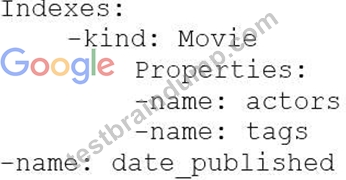
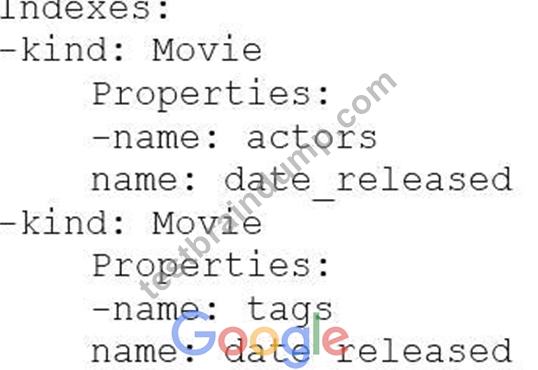
You are deploying a new storage system for your mobile application, which is a media streaming service. You decide the best fit is Google Cloud Datastore. You have entities with multiple properties, some of which can take on multiple values. For example, in the entity 'Movie' the property 'actors' and the property 'tags' have multiple values but the property 'date released' does not. A typical query would ask for all movies with actor=<actorname> ordered by date_released or all movies with tag=Comedy ordered by date_released. How should you avoid a combinatorial explosion in the number of indexes?
- A. Manually configure the index in your index config as follows:
- B. Set the following in your entity options: exclude_from_indexes = 'actors, tags'
- C. Set the following in your entity options: exclude_from_indexes = 'date_published'
- D. Manually configure the index in your index config as follows:
Answer: D
NEW QUESTION # 36
Dataproc clusters contain many configuration files. To update these files, you will need to use the --properties option. The format for the option is: file_prefix:property=_____.
- A. id
- B. value
- C. null
- D. details
Answer: B
Explanation:
To make updating files and properties easy, the --properties command uses a special format to specify the configuration file and the property and value within the file that should be updated. The formatting is as follows: file_prefix:property=value.
NEW QUESTION # 37
You are running a Dataflow streaming pipeline, with Streaming Engine and Horizontal Autoscaling enabled. You have set the maximum number of workers to 1000. The input of your pipeline is Pub/Sub messages with notifications from Cloud Storage One of the pipeline transforms reads CSV files and emits an element for every CSV line. The Job performance is low. the pipeline is using only 10 workers, and you notice that the autoscaler is not spinning up additional workers. What should you do to improve performance?
- A. Change the pipeline code, and introduce a Reshuffle step to prevent fusion.
- B. Update the job to increase the maximum number of workers.
- C. Use Dataflow Prime, and enable Right Fitting to increase the worker resources.
- D. Enable Vertical Autoscaling to let the pipeline use larger workers.
Answer: C
Explanation:
Fusion is an optimization technique that Dataflow applies to merge multiple transforms into a single stage. This reduces the overhead of shuffling data between stages, but it can also limit the parallelism and scalability of the pipeline. By introducing a Reshuffle step, you can force Dataflow to split the pipeline into multiple stages, which can increase the number of workers that can process the data in parallel. Reshuffle also adds randomness to the data distribution, which can help balance the workload across workers and avoid hot keys or skewed data. Reference:
1: Streaming pipelines
2: Batch vs Streaming Performance in Google Cloud Dataflow
3: Deploy Dataflow pipelines
4: How Distributed Shuffle improves scalability and performance in Cloud Dataflow pipelines
5: Managing costs for Dataflow batch and streaming data processing
NEW QUESTION # 38
MJTelco Case Study
Company Overview
MJTelco is a startup that plans to build networks in rapidly growing, underserved markets around the world.
The company has patents for innovative optical communications hardware. Based on these patents, they can create many reliable, high-speed backbone links with inexpensive hardware.
Company Background
Founded by experienced telecom executives, MJTelco uses technologies originally developed to overcome communications challenges in space. Fundamental to their operation, they need to create a distributed data infrastructure that drives real-time analysis and incorporates machine learning to continuously optimize their topologies. Because their hardware is inexpensive, they plan to overdeploy the network allowing them to account for the impact of dynamic regional politics on location availability and cost.
Their management and operations teams are situated all around the globe creating many-to-many relationship between data consumers and provides in their system. After careful consideration, they decided public cloud is the perfect environment to support their needs.
Solution Concept
MJTelco is running a successful proof-of-concept (PoC) project in its labs. They have two primary needs:
* Scale and harden their PoC to support significantly more data flows generated when they ramp to more than 50,000 installations.
* Refine their machine-learning cycles to verify and improve the dynamic models they use to control topology definition.
MJTelco will also use three separate operating environments - development/test, staging, and production - to meet the needs of running experiments, deploying new features, and serving production customers.
Business Requirements
* Scale up their production environment with minimal cost, instantiating resources when and where needed in an unpredictable, distributed telecom user community.
* Ensure security of their proprietary data to protect their leading-edge machine learning and analysis.
* Provide reliable and timely access to data for analysis from distributed research workers
* Maintain isolated environments that support rapid iteration of their machine-learning models without affecting their customers.
Technical Requirements
Ensure secure and efficient transport and storage of telemetry data
Rapidly scale instances to support between 10,000 and 100,000 data providers with multiple flows each.
Allow analysis and presentation against data tables tracking up to 2 years of data storing approximately 100m records/day Support rapid iteration of monitoring infrastructure focused on awareness of data pipeline problems both in telemetry flows and in production learning cycles.
CEO Statement
Our business model relies on our patents, analytics and dynamic machine learning. Our inexpensive hardware is organized to be highly reliable, which gives us cost advantages. We need to quickly stabilize our large distributed data pipelines to meet our reliability and capacity commitments.
CTO Statement
Our public cloud services must operate as advertised. We need resources that scale and keep our data secure. We also need environments in which our data scientists can carefully study and quickly adapt our models. Because we rely on automation to process our data, we also need our development and test environments to work as we iterate.
CFO Statement
The project is too large for us to maintain the hardware and software required for the data and analysis. Also, we cannot afford to staff an operations team to monitor so many data feeds, so we will rely on automation and infrastructure. Google Cloud's machine learning will allow our quantitative researchers to work on our high- value problems instead of problems with our data pipelines.
Given the record streams MJTelco is interested in ingesting per day, they are concerned about the cost of Google BigQuery increasing. MJTelco asks you to provide a design solution. They require a single large data table called tracking_table. Additionally, they want to minimize the cost of daily queries while performing fine-grained analysis of each day's events. They also want to use streaming ingestion. What should you do?
- A. Create a partitioned table called tracking_table and include a TIMESTAMP column.
- B. Create a table called tracking_table and include a DATE column.
- C. Create sharded tables for each day following the pattern tracking_table_YYYYMMDD.
- D. Create a table called tracking_table with a TIMESTAMP column to represent the day.
Answer: A
NEW QUESTION # 39
You've migrated a Hadoop job from an on-prem cluster to dataproc and GCS. Your Spark job is a complicated analytical workload that consists of many shuffing operations and initial data are parquet files (on average 200-400 MB size each). You see some degradation in performance after the migration to Dataproc, so you'd like to optimize for it. You need to keep in mind that your organization is very cost- sensitive, so you'd like to continue using Dataproc on preemptibles (with 2 non-preemptible workers only) for this workload.
What should you do?
- A. Switch to TFRecords formats (appr. 200MB per file) instead of parquet files.
- B. Switch from HDDs to SSDs, override the preemptible VMs configuration to increase the boot disk size.
- C. Switch from HDDs to SSDs, copy initial data from GCS to HDFS, run the Spark job and copy results back to GCS.
- D. Increase the size of your parquet files to ensure them to be 1 GB minimum.
Answer: B
Explanation:
In order to increase performance switch to SSD which will be costly, so to tackle this increase the boot disk size, bootsize is worker node cache size 100 Gb.
NEW QUESTION # 40
You want to archive data in Cloud Storage. Because some data is very sensitive, you want to use the
"Trust No One" (TNO) approach to encrypt your data to prevent the cloud provider staff from decrypting your data. What should you do?
- A. Use gcloud kms keys create to create a symmetric key. Then use gcloud kms encrypt to encrypt each archival file with the key and unique additional authenticated data (AAD). Use gsutil to upload each encrypted file to the Cloud Storage bucket, and keep the AAD outside of Google cp Cloud.
- B. Use gcloud kms keys create to create a symmetric key. Then use gcloud kms encrypt to encrypt each archival file with the key. Use gsutil cp to upload each encrypted file to the Cloud Storage bucket.
Manually destroy the key previously used for encryption, and rotate the key once. - C. Specify customer-supplied encryption key (CSEK) in the .boto configuration file. Use gsutil cp to upload each archival file to the Cloud Storage bucket. Save the CSEK in Cloud Memorystore as permanent storage of the secret.
- D. Specify customer-supplied encryption key (CSEK) in the .boto configuration file. Use gsutil cp to upload each archival file to the Cloud Storage bucket. Save the CSEK in a different project that only the security team can access.
Answer: D
NEW QUESTION # 41
Case Study 2 - MJTelco
Company Overview
MJTelco is a startup that plans to build networks in rapidly growing, underserved markets around the world.
The company has patents for innovative optical communications hardware. Based on these patents, they can create many reliable, high-speed backbone links with inexpensive hardware.
Company Background
Founded by experienced telecom executives, MJTelco uses technologies originally developed to overcome communications challenges in space. Fundamental to their operation, they need to create a distributed data infrastructure that drives real-time analysis and incorporates machine learning to continuously optimize their topologies. Because their hardware is inexpensive, they plan to overdeploy the network allowing them to account for the impact of dynamic regional politics on location availability and cost.
Their management and operations teams are situated all around the globe creating many-to-many relationship between data consumers and provides in their system. After careful consideration, they decided public cloud is the perfect environment to support their needs.
Solution Concept
MJTelco is running a successful proof-of-concept (PoC) project in its labs. They have two primary needs:
* Scale and harden their PoC to support significantly more data flows generated when they ramp to more than 50,000 installations.
* Refine their machine-learning cycles to verify and improve the dynamic models they use to control topology definition.
MJTelco will also use three separate operating environments - development/test, staging, and production - to meet the needs of running experiments, deploying new features, and serving production customers.
Business Requirements
* Scale up their production environment with minimal cost, instantiating resources when and where needed in an unpredictable, distributed telecom user community.
* Ensure security of their proprietary data to protect their leading-edge machine learning and analysis.
* Provide reliable and timely access to data for analysis from distributed research workers
* Maintain isolated environments that support rapid iteration of their machine-learning models without affecting their customers.
Technical Requirements
* Ensure secure and efficient transport and storage of telemetry data
* Rapidly scale instances to support between 10,000 and 100,000 data providers with multiple flows each.
* Allow analysis and presentation against data tables tracking up to 2 years of data storing approximately
100m records/day
* Support rapid iteration of monitoring infrastructure focused on awareness of data pipeline problems both in telemetry flows and in production learning cycles.
CEO Statement
Our business model relies on our patents, analytics and dynamic machine learning. Our inexpensive hardware is organized to be highly reliable, which gives us cost advantages. We need to quickly stabilize our large distributed data pipelines to meet our reliability and capacity commitments.
CTO Statement
Our public cloud services must operate as advertised. We need resources that scale and keep our data secure. We also need environments in which our data scientists can carefully study and quickly adapt our models. Because we rely on automation to process our data, we also need our development and test environments to work as we iterate.
CFO Statement
The project is too large for us to maintain the hardware and software required for the data and analysis.
Also, we cannot afford to staff an operations team to monitor so many data feeds, so we will rely on automation and infrastructure. Google Cloud's machine learning will allow our quantitative researchers to work on our high-value problems instead of problems with our data pipelines.
You need to compose visualization for operations teams with the following requirements:
* Telemetry must include data from all 50,000 installations for the most recent 6 weeks (sampling once every minute)
* The report must not be more than 3 hours delayed from live data.
* The actionable report should only show suboptimal links.
* Most suboptimal links should be sorted to the top.
* Suboptimal links can be grouped and filtered by regional geography.
* User response time to load the report must be <5 seconds.
You create a data source to store the last 6 weeks of data, and create visualizations that allow viewers to see multiple date ranges, distinct geographic regions, and unique installation types. You always show the latest data without any changes to your visualizations. You want to avoid creating and updating new visualizations each month. What should you do?
- A. Look through the current data and compose a small set of generalized charts and tables bound to criteria filters that allow value selection.
- B. Load the data into relational database tables, write a Google App Engine application that queries all rows, summarizes the data across each criteria, and then renders results using the Google Charts and visualization API.
- C. Look through the current data and compose a series of charts and tables, one for each possible combination of criteria.
- D. Export the data to a spreadsheet, compose a series of charts and tables, one for each possible combination of criteria, and spread them across multiple tabs.
Answer: A
NEW QUESTION # 42
You are building a new application that you need to collect data from in a scalable way. Data arrives continuously from the application throughout the day, and you expect to generate approximately 150 GB of JSON data per day by the end of the year. Your requirements are:
Decoupling producer from consumer
Space and cost-efficient storage of the raw ingested data, which is to be stored indefinitely
Near real-time SQL query
Maintain at least 2 years of historical data, which will be queried with SQ
Which pipeline should you use to meet these requirements?
- A. Create an application that publishes events to Cloud Pub/Sub, and create Spark jobs on Cloud Dataproc to convert the JSON data to Avro format, stored on HDFS on Persistent Disk.
- B. Create an application that publishes events to Cloud Pub/Sub, and create a Cloud Dataflow pipeline that transforms the JSON event payloads to Avro, writing the data to Cloud Storage and BigQuery.
- C. Create an application that provides an API. Write a tool to poll the API and write data to Cloud Storage as gzipped JSON files.
- D. Create an application that writes to a Cloud SQL database to store the data. Set up periodic exports of the database to write to Cloud Storage and load into BigQuery.
Answer: C
NEW QUESTION # 43
Your United States-based company has created an application for assessing and responding to user actions.
The primary table's data volume grows by 250,000 records per second. Many third parties use your application's APIs to build the functionality into their own frontend applications. Your application's APIs should comply with the following requirements:
* Single global endpoint
* ANSI SQL support
* Consistent access to the most up-to-date data
What should you do?
- A. Implement BigQuery with no region selected for storage or processing.
- B. Implement Cloud SQL for PostgreSQL with the master in Norht America and read replicas in Asia and Europe.
- C. Implement Cloud Spanner with the leader in North America and read-only replicas in Asia and Europe.
- D. Implement Cloud Bigtable with the primary cluster in North America and secondary clusters in Asia and Europe.
Answer: C
NEW QUESTION # 44
Which of the following is not possible using primitive roles?
- A. Give UserA owner access and UserB editor access for all datasets in a project.
- B. Give GroupA owner access and GroupB editor access for all datasets in a project.
- C. Give a user viewer access to BigQuery and owner access to Google Compute Engine instances.
- D. Give a user access to view all datasets in a project, but not run queries on them.
Answer: D
Explanation:
Primitive roles can be used to give owner, editor, or viewer access to a user or group, but they can't be used to separate data access permissions from job-running permissions.
NEW QUESTION # 45
Which of the following statements is NOT true regarding Bigtable access roles?
- A. You can configure access control only at the project level.
- B. To give a user access to only one table in a project, grant the user the Bigtable Editor role for that table.
- C. To give a user access to only one table in a project, you must configure access through your application.
- D. Using IAM roles, you cannot give a user access to only one table in a project, rather than all tables in a project.
Answer: B
Explanation:
For Cloud Bigtable, you can configure access control at the project level. For example, you can grant the ability to:
Read from, but not write to, any table within the project. Read from and write to any table within the project, but not manage instances. Read from and write to any table within the project, and manage instances.
Reference: https://cloud.google.com/bigtable/docs/access-control
NEW QUESTION # 46
Which of the following job types are supported by Cloud Dataproc (select 3 answers)?
- A. Pig
- B. Spark
- C. Hive
- D. YARN
Answer: A,B,C
Explanation:
Cloud Dataproc provides out-of-the box and end-to-end support for many of the most popular job types, including Spark, Spark SQL, PySpark, MapReduce, Hive, and Pig jobs.
NEW QUESTION # 47
You store and analyze your relational data in BigQuery on Google Cloud with all data that resides in US regions. You also have a variety of object stores across Microsoft Azure and Amazon Web Services (AWS), also in US regions. You want to query all your data in BigQuery daily with as little movement of data as possible. What should you do?
- A. Create a Dataflow pipeline to ingest files from Azure and AWS to BigQuery.
- B. Load files from AWS and Azure to Cloud Storage with Cloud Shell gautil rsync arguments.
- C. Use BigQuery Data Transfer Service to load files from Azure and AWS into BigQuery.
- D. Use the BigQuery Omni functionality and BigLake tables to query files in Azure and AWS.
Answer: A
Explanation:
BigQuery Omni is a multi-cloud analytics solution that lets you use the BigQuery interface to analyze data stored in other public clouds, such as AWS and Azure, without moving or copying the data. BigLake tables are a type of external table that let you query structured data in external data stores with access delegation. By using BigQuery Omni and BigLake tables, you can query data in AWS and Azure object stores directly from BigQuery, with minimal data movement and consistent performance. Reference:
1: Introduction to BigLake tables
2: Deep dive on how BigLake accelerates query performance
3: BigQuery Omni and BigLake (Analytics Data Federation on GCP)
NEW QUESTION # 48
You are part of a healthcare organization where data is organized and managed by respective data owners in various storage services. As a result of this decentralized ecosystem, discovering and managing data has become difficult You need to quickly identify and implement a cost-optimized solution to assist your organization with the following
* Data management and discovery
* Data lineage tracking
* Data quality validation
How should you build the solution?
- A. Build a new data discovery tool on Google Kubernetes Engine that helps with new source onboarding and data lineage tracking.
- B. Use BigLake to convert the current solution into a data lake architecture.
- C. Use Dataplex to manage data, track data lineage, and perform data quality validation.
- D. Use BigOuery to track data lineage, and use Dataprep to manage data and perform data quality validation.
Answer: C
Explanation:
Dataplex is a Google Cloud service that provides a unified data fabric for data lakes and data warehouses. It enables data governance, management, and discovery across multiple data domains, zones, and assets. Dataplex also supports data lineage tracking, which shows the origin and transformation of data over time. Dataplex also integrates with Dataprep, a data preparation and quality tool that allows users to clean, enrich, and transform data using a visual interface. Dataprep can also monitor data quality and detect anomalies using machine learning. Therefore, Dataplex is the most suitable solution for the given scenario, as it meets all the requirements of data management and discovery, data lineage tracking, and data quality validation. Reference:
Dataplex overview
Automate data governance, extend your data fabric with Dataplex-BigLake integration Dataprep documentation
NEW QUESTION # 49
What Dataflow concept determines when a Window's contents should be output based on certain criteria being met?
- A. Windows
- B. Triggers
- C. OutputCriteria
- D. Sessions
Answer: B
Explanation:
Triggers control when the elements for a specific key and window are output. As elements arrive, they are put into one or more windows by a Window transform and its associated WindowFn, and then passed to the associated Trigger to determine if the Windows contents should be output.
NEW QUESTION # 50
Your company is performing data preprocessing for a learning algorithm in Google Cloud Dataflow.
Numerous data logs are being are being generated during this step, and the team wants to analyze them.
Due to the dynamic nature of the campaign, the data is growing exponentially every hour. The data scientists have written the following code to read the data for a new key features in the logs.
BigQueryIO.Read
.named("ReadLogData")
.from("clouddataflow-readonly:samples.log_data")
You want to improve the performance of this data read. What should you do?
- A. Use of both the Google BigQuery TableSchema and TableFieldSchema classes.
- B. Call a transform that returns TableRow objects, where each element in the PCollexction represents a single row in the table.
- C. Use .fromQuery operation to read specific fields from the table.
- D. Specify the Tableobject in the code.
Answer: C
Explanation:
BigQueryIO.read.from() directly reads the whole table from BigQuery. This function exports the whole table to temporary files in Google Cloud Storage, where it will later be read from. This requires almost no computation, as it only performs an export job, and later Dataflow reads from GCS (not from BigQuery).
BigQueryIO.read.fromQuery() executes a query and then reads the results received after the query execution. Therefore, this function is more time-consuming, given that it requires that a query is first executed (which will incur in the corresponding economic and computational costs).
NEW QUESTION # 51
You work for a shipping company that has distribution centers where packages move on delivery lines to route them properly. The company wants to add cameras to the delivery lines to detect and track any visual damage to the packages in transit. You need to create a way to automate the detection of damaged packages and flag them for human review in real time while the packages are in transit. Which solution should you choose?
- A. Train an AutoML model on your corpus of images, and build an API around that model to integrate with the package tracking applications.
- B. Use the Cloud Vision API to detect for damage, and raise an alert through Cloud Functions. Integrate the package tracking applications with this function.
- C. Use TensorFlow to create a model that is trained on your corpus of images. Create a Python notebook in Cloud Datalab that uses this model so you can analyze for damaged packages.
- D. Use BigQuery machine learning to be able to train the model at scale, so you can analyze the packages in batches.
Answer: D
NEW QUESTION # 52
Your company produces 20,000 files every hour. Each data file is formatted as a comma separated values
(CSV) file that is less than 4 KB. All files must be ingested on Google Cloud Platform before they can be
processed. Your company site has a 200 ms latency to Google Cloud, and your Internet connection
bandwidth is limited as 50 Mbps. You currently deploy a secure FTP (SFTP) server on a virtual machine in
Google Compute Engine as the data ingestion point. A local SFTP client runs on a dedicated machine to
transmit the CSV files as is. The goal is to make reports with data from the previous day available to the
executives by 10:00 a.m. each day. This design is barely able to keep up with the current volume, even
though the bandwidth utilization is rather low.
You are told that due to seasonality, your company expects the number of files to double for the next three
months. Which two actions should you take? (Choose two.)
- A. Create an S3-compatible storage endpoint in your network, and use Google Cloud Storage Transfer
Service to transfer on-premices data to the designated storage bucket. - B. Assemble 1,000 files into a tape archive (TAR) file. Transmit the TAR files instead, and disassemble
the CSV files in the cloud upon receiving them. - C. Contact your internet service provider (ISP) to increase your maximum bandwidth to at least 100 Mbps.
- D. Introduce data compression for each file to increase the rate file of file transfer.
- E. Redesign the data ingestion process to use gsutil tool to send the CSV files to a storage bucket in
parallel.
Answer: A,E
NEW QUESTION # 53
You work for a shipping company that uses handheld scanners to read shipping labels. Your company has strict data privacy standards that require scanners to only transmit recipients' personally identifiable information (PII) to analytics systems, which violates user privacy rules. You want to quickly build a scalable solution using cloud-native managed services to prevent exposure of PII to the analytics systems. What should you do?
- A. Create an authorized view in BigQuery to restrict access to tables with sensitive data.
- B. Build a Cloud Function that reads the topics and makes a call to the Cloud Data Loss Prevention API.
Use the tagging and confidence levels to either pass or quarantine the data in a bucket for review. - C. Install a third-party data validation tool on Compute Engine virtual machines to check the incoming data for sensitive information.
- D. Use Stackdriver logging to analyze the data passed through the total pipeline to identify transactions that may contain sensitive information.
Answer: B
NEW QUESTION # 54
Your company's customer and order databases are often under heavy load. This makes performing analytics against them difficult without harming operations. The databases are in a MySQL cluster, with nightly backups taken using mysqldump. You want to perform analytics with minimal impact on operations. What should you do?
- A. Use an ETL tool to load the data from MySQL into Google BigQuery.
- B. Connect an on-premises Apache Hadoop cluster to MySQL and perform ETL.
- C. Mount the backups to Google Cloud SQL, and then process the data using Google Cloud Dataproc.
- D. Add a node to the MySQL cluster and build an OLAP cube there.
Answer: B
NEW QUESTION # 55
To give a user read permission for only the first three columns of a table, which access control method would you use?
- A. Predefined role
- B. It's not possible to give access to only the first three columns of a table.
- C. Authorized view
- D. Primitive role
Answer: C
Explanation:
An authorized view allows you to share query results with particular users and groups without giving them read access to the underlying tables. Authorized views can only be created in a dataset that does not contain the tables queried by the view.
When you create an authorized view, you use the view's SQL query to restrict access to only the rows and columns you want the users to see.
Reference: https://cloud.google.com/bigquery/docs/views#authorized-views
NEW QUESTION # 56
You have terabytes of customer behavioral data streaming from Google Analytics into BigQuery daily Your customers' information, such as their preferences, is hosted on a Cloud SQL for MySQL database Your CRM database is hosted on a Cloud SQL for PostgreSQL instance. The marketing team wants to use your customers' information from the two databases and the customer behavioral data to create marketing campaigns for yearly active customers. You need to ensure that the marketing team can run the campaigns over 100 times a day on typical days and up to 300 during sales. At the same time you want to keep the load on the Cloud SQL databases to a minimum. What should you do?
- A. Create BigQuery connections to both Cloud SQL databases Use BigQuery federated queries on the two databases and the Google Analytics data on BigQuery to run these queries.
- B. Create a job on Apache Spark with Dataproc Serverless to query both Cloud SQL databases and the Google Analytics data on BigQuery for these queries.
- C. Create streams in Datastream to replicate the required tables from both Cloud SQL databases to BigQuery for these queries.
- D. Create a Dataproc cluster with Trino to establish connections to both Cloud SQL databases and BigQuery, to execute the queries.
Answer: C
Explanation:
Datastream is a serverless Change Data Capture (CDC) and replication service that allows you to stream data changes from Oracle and MySQL databases to Google Cloud services such as BigQuery, Cloud Storage, Cloud SQL, and Pub/Sub. Datastream captures and delivers database changes in real-time, with minimal impact on the source database performance. Datastream also preserves the schema and data types of the source database, and automatically creates and updates the corresponding tables in BigQuery.
By using Datastream, you can replicate the required tables from both Cloud SQL databases to BigQuery, and keep them in sync with the source databases. This way, you can reduce the load on the Cloud SQL databases, as the marketing team can run their queries on the BigQuery tables instead of the Cloud SQL tables. You can also leverage the scalability and performance of BigQuery to query the customer behavioral data from Google Analytics and the customer information from the replicated tables. You can run the queries as frequently as needed, without worrying about the impact on the Cloud SQL databases.
Option A is not a good solution, as BigQuery federated queries allow you to query external data sources such as Cloud SQL databases, but they do not reduce the load on the source databases. In fact, federated queries may increase the load on the source databases, as they need to execute the query statements on the external data sources and return the results to BigQuery. Federated queries also have some limitations, such as data type mappings, quotas, and performance issues.
Option C is not a good solution, as creating a Dataproc cluster with Trino would require more resources and management overhead than using Datastream. Trino is a distributed SQL query engine that can connect to multiple data sources, such as Cloud SQL and BigQuery, and execute queries across them. However, Trino requires a Dataproc cluster to run, which means you need to provision, configure, and monitor the cluster nodes. You also need to install and configure the Trino connector for Cloud SQL and BigQuery, and write the queries in Trino SQL dialect. Moreover, Trino does not replicate or sync the data from Cloud SQL to BigQuery, so the load on the Cloud SQL databases would still be high.
Option D is not a good solution, as creating a job on Apache Spark with Dataproc Serverless would require more coding and processing power than using Datastream. Apache Spark is a distributed data processing framework that can read and write data from various sources, such as Cloud SQL and BigQuery, and perform complex transformations and analytics on them. Dataproc Serverless is a serverless Spark service that allows you to run Spark jobs without managing clusters. However, Spark requires you to write code in Python, Scala, Java, or R, and use the Spark connector for Cloud SQL and BigQuery to access the data sources. Spark also does not replicate or sync the data from Cloud SQL to BigQuery, so the load on the Cloud SQL databases would still be high. References: Datastream overview | Datastream | Google Cloud, Datastream concepts | Datastream | Google Cloud, Datastream quickstart | Datastream | Google Cloud, Introduction to federated queries | BigQuery | Google Cloud, Trino overview | Dataproc Documentation | Google Cloud, Dataproc Serverless overview | Dataproc Documentation | Google Cloud, Apache Spark overview | Dataproc Documentation | Google Cloud.
NEW QUESTION # 57
......
Google Professional-Data-Engineer exam is a certification offered by Google to those who want to showcase their expertise in designing, building, and maintaining data processing systems on the Google Cloud Platform. Google Certified Professional Data Engineer Exam certification is designed for professionals who have a deep understanding of data engineering and can leverage Google Cloud technologies to create scalable and efficient data pipelines. Professional-Data-Engineer exam assesses the candidate's ability to design data processing systems, build and operationalize data pipelines, and manage and monitor data processing infrastructure.
Actual Professional-Data-Engineer Exam Recently Updated Questions with Free Demo: https://www.testbraindump.com/Professional-Data-Engineer-exam-prep.html
Valid Professional-Data-Engineer exam with Google Real Exam Questions: https://drive.google.com/open?id=1Mgyi4WLbNZRQtmyV8z779UqvetsceXoH
