
Pass 350-501 Exam in First Attempt Guaranteed 100% Cover Real Exam Questions [Nov-2025]
Valid 350-501 test answers & Cisco 350-501 exam pdf
To prepare for the Cisco 350-501 exam, candidates should have a strong foundation in networking concepts and technologies, as well as experience working with Cisco networking equipment. Cisco offers a variety of training courses and resources to help candidates prepare for the exam, including classroom training, e-learning modules, and study materials.
Cisco 350-501 exam covers a wide range of topics related to service provider network technologies. Candidates are tested on their understanding of routing protocols such as OSPF, BGP, and IS-IS, as well as MPLS and VPN technologies. They are also tested on their knowledge of QoS and how it is used to prioritize traffic on service provider networks. 350-501 exam includes both multiple choice and simulation questions, which require candidates to demonstrate their ability to configure and troubleshoot service provider network technologies.
Exam Overview
The Cisco 350-501 test is 2 hours long and you will need to clear about 100 multiple-choice questions. To pass it, it is required that you get at least 825 points after answering the questions. The exam will cost you $400, but the price can vary according to the country you live in. Thus, because of the possible taxes, you can pay less or more for the application.
NEW QUESTION # 241
Refer to the exhibit:
Based on the show/ command output, which result m true after BGP session is established?
- A. The IOS XR router does not advertise any routes to the neighbor 192.168.2.2,but it accepts all routes from 192.168.2.2.
- B. The IOS XR router advertises all routes to the neighbor 192.168.2.2, but it does not accept any routes from 192.168.2.2
- C. The IOS XR router advertises and accepts all routes to and from eBGP neighbor 192.168.2.2
- D. No routes are accepted from the neighbor 192.168.2.2, nor are any routes advertised to it
Answer: D
NEW QUESTION # 242
Refer to the exhibit.
An engineer configured BGP summarization on a customer's network. Which route is advertised to BGP peers?
- A. 192168.0.5/30
- B. 192.168.1.0/24
- C. 192.0.0.0/16
- D. 192168.0.0/16
Answer: C
Explanation:
The configuration snippet in the exhibit shows that BGP summarization is configured with the "aggregate-address" command followed by an IP address and a subnet mask, and then the "summary-only" and "as-set" options. The IP address is 192.168.0.0, and the subnet mask is 255.255.0.0, which corresponds to a /16 prefix length (indicating that the first 16 bits of the IP address are the network portion). However, there seems to be a typo in option B as it's not a valid IP address format; hence option A is correct with an assumption of typo error.
NEW QUESTION # 243
Which configuration modifies Local Packet Transport Services hardware policies?
A)
B)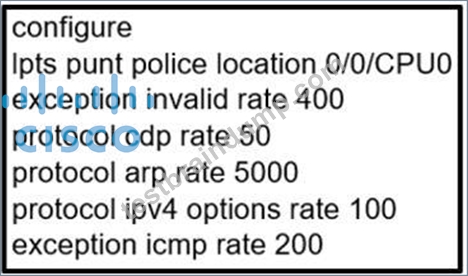
C)
D)
- A. Option B
- B. Option A
- C. Option C
- D. Option D
Answer: C
NEW QUESTION # 244
Refer to the exhibit:
Export statistics received do not include the BGP next hop.
Which statement about the NetFlow export statistics is true?
- A. Loopback 0 must be participating in BGP for it to be included in the export statistics
- B. To include the BGP next hop in the export statistics, those keywords must be included with the version
9 entry. - C. The origin AS and the peer-as will be included in the export statistics
- D. Only the origin AS of the source router will be included in the export statistics.
Answer: C
NEW QUESTION # 245
Drag and drop the methods of Cisco MPLS TE tunnel traffic assignment from the left onto their characteristics on the right.
Answer:
Explanation:
NEW QUESTION # 246
Refer to the exhibit. An engineer at a new ISP must configure many Cisco devices in the data center. To make the process more efficient, the engineer decides to automate the task with a REST API. Which action does this JSON script automate?
- A. Configure a physical interface on the router with an IP address.
- B. Configure a physical interface on the router with an IP address and then create a loopback interface.
- C. Configure the IP address for the existing loopback interface.
- D. Delete the existing loopback Interface and replace it with a new loopback interface.
Answer: C
NEW QUESTION # 247
Drag and drop the multicast concepts from the left onto the correct descnpt.ons on the right.
Answer:
Explanation:
NEW QUESTION # 248
Which configuration enables BGP FlowSpec client function and installation of policies on all local interfaces?
A)
B)
C)
D)
- A. Option B
- B. Option A
- C. Option C
- D. Option D
Answer: C
NEW QUESTION # 249
Refer to the exhibit:
Which information is provided for traceback analysis when this configuration is applied?
- A. BGP version
- B. source interface
- C. packet size distribution
- D. IP sub flow cache
Answer: C
NEW QUESTION # 250
Simulation2
TOPOLOGY
Refer to the exhibit.


Answer:
Explanation:
R1
R2

NEW QUESTION # 251
How does SR policy operate in Segment Routing Traffic Engineering?
- A. An SR policy for color and endpoint is deactivated at the headend as soon as the headend learns a valid candidate path for the policy.
- B. An active SR policy installs a BSID-keyed entry in the forwarding table to steer the packets that match the entry to the SR policy SID-list.
- C. When a set of SID lists is associated with the SR policy designated path, traffic steering is ECMP- based according to the qualified cost of each SID-list.
- D. When "invalidation drop" behavior occurs, the SR policy forwarding entry is removed and the router drops all traffic that is steered into the SR policy.
Answer: B
NEW QUESTION # 252
Drag and drop the multicast concepts from the left onto the correct descnpt.ons on the right.
Answer:
Explanation:

NEW QUESTION # 253
Refer to me exhibit.
A network operator recently configured BGP FlowSpec for me internal IT network What will be inferred from the configuration deployed on me network?
- A. The policy is configured locally on CSRl and drops all traffic for TCP ports 80 and 443
- B. The policy is learned via BGP FlowSpec and drops all traffic for TCP ports 80 and 443
- C. The policy is configured locally on CSR1 and currently has no active traffic
- D. The policy is warned via BC FlowSpec aid has active traffic
Answer: A
NEW QUESTION # 254 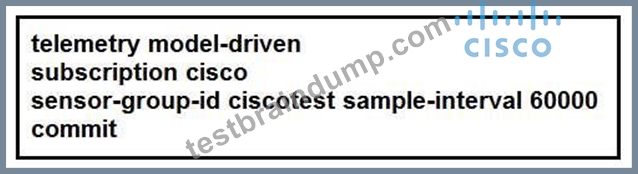
Refer to the exhibit. What is the effect of this configuration applied on the IOS XR router?
- A. It is used to create a streaming subscription with a 60-second interval
- B. It is used to enable gRPC
- C. It is used to set up configuration to poll network data
- D. It is used to create a streaming subscription with a 600-second interval
Answer: A
Explanation:
Section: Automation and Assurance
Explanation/Reference:
NEW QUESTION # 255
An engineer implemented LDP protocol on the ISP network. The engineer must ensure that there are no packet loss issues when IGP and LDP protocols are not synchronized. Which configuring must the engineer implement so that the IGP routing protocol will wait until LDP convergence is completed?
- A. Configure LDP sessions protection on the network.
- B. Disable MPLS LDP IGP synchronization on the network.
- C. Disable IP CEF routers running LDP and enable LDP protocol.
- D. Configure MPLS LDP IGP synchronization on the network.
Answer: D
Explanation:
* To prevent packet loss when IGP (Interior Gateway Protocol) and LDP (Label Distribution Protocol) are not synchronized, enabling MPLS LDP IGP synchronization is crucial. This synchronization ensures that the IGP routing protocol (such as OSPF or IS-IS) waits until LDP convergence is completed before advertising labels for MPLS traffic. It helps maintain consistency between the IGP and LDP databases.
Implementing and Operating Cisco Service Provider Network Core Technologies course materials.
NEW QUESTION # 256 
Refer to the exhibit. You are configuring an administrative domain in the given multi-vendor environment with PIM-SM.
Which feature can you implement so that devices can dynamically learn the RP?
- A. Auto-RP
- B. BSR
- C. BIDIP-PIM
- D. SSM
Answer: A
Explanation:
Section: Services
NEW QUESTION # 257
Which utility must be used to locate MPLS faults?
- A. MPLS LSP ping
- B. EEM
- C. MPLStraceroute
- D. QoS
Answer: A
Explanation:
The MPLS LSP ping is the utility that must be used to locate MPLS faults. It is specifically designed to troubleshoot Multiprotocol Label Switching (MPLS) by sending a ping through the MPLS network to verify the path and identify any issues.
Cisco provides a guide on MPLS Troubleshooting
NEW QUESTION # 258
......
350-501 Exam Questions – Valid 350-501 Dumps Pdf: https://www.testbraindump.com/350-501-exam-prep.html
Verified 350-501 dumps Q&As - Pass Guarantee: https://drive.google.com/open?id=1HHa0ZNMn0LlCNlt7ewFZCpIsJrvaD4lb
