
The New ACP-520 2024 Updated Verified Study Guides & Best Courses
Authentic ACP-520 Exam Dumps PDF - 2024 Updated
NEW QUESTION # 31
Previously, your company had two Cloud organizations as shown.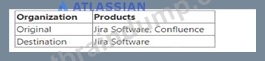
Just now, all products from Original were transferred to Destination. Afterward, Original was deleted.
How does Jira Software appear on the Overview page of the Destination organization?
- A. as two products under the Destination URL only
- B. as a single product under the Destination URL
- C. as two products under the Original URL and Destination URL
- D. as a single product under the Original URL
Answer: B
Explanation:
Explanation
After the products from Original were transferred to Destination, Jira Software will appear as a single product under the Destination URL. This is because the Original organization was deleted, so there is no longer a separate URL for it.
References:
How to prepare for ACP-520: Atlassian Cloud Organization Admin Certification, section "Manage multiple sites and products" Transfer products to another organization, subsection "What happens after you transfer products?"
NEW QUESTION # 32
A secure pathway needs to be configured between a self-managed Jira Software instance and several Atlassian Cloud products.
Identify one configuration step that must be done in a self-managed instance.
- A. generate a security key
- B. create an IP allowlist
- C. configure multiple application tunnels
- D. add an upstream port
- E. create an application tunnel
Answer: D
Explanation:
Explanation
Adding an upstream port is one of the configuration steps that must be done in a self-managed instance to enable a secure pathway between a self-managed Jira Software instance and several Atlassian Cloud products.
An upstream port is the port on your self-managed instance that receives traffic from the application tunnel.
You need to configure the upstream port for each product that you want to connect to the tunnel.
References = Configure required connections and upstream ports and Create an application tunnel to your self-managed instance
NEW QUESTION # 33
An application tunnel was just configured and its status is Connected.
Where does it reside?
- A. between two Cloud products on two Cloud sites within the same organization
- B. between a single Cloud product and two Data Center instances
- C. between two Cloud products on two Cloud sites in different organizations
- D. between two Cloud products and two Data Center instances
- E. between two Cloud products and a single Data Center instance
- F. between two Cloud products on a single Cloud site within an organization
Answer: E
Explanation:
Explanation
Application tunnels provide a secure pathway between your Atlassian cloud organization and Data Center or Server instances that live in your network. You can link only one such organization (and its multiple products) to a single self-managed instance, for example Confluence Data Center.
References: What are application tunnels?, Application tunnels overview
NEW QUESTION # 34
Which statement is true about Atlassian Access?
- A. It calculates billing across multiple Cloud organizations.
- B. It complies with both Cloud and Data Center platforms.
- C. It enforces policies for both managed and non-managed accounts.
- D. It manages all your company's products, including shadow IT.
- E. It works across multiple sites within an organization.
Answer: E
Explanation:
Explanation
Atlassian Access is a subscription that connects your Atlassian cloud products to your identity provider. It allows you to enable enterprise-grade authentication features, and additional oversight, across your company domains1.
References: Understand Atlassian Access, Atlassian Access: Enhanced Cloud Data Security & Governance
NEW QUESTION # 35
You went to the Jira Software product pricing page in order to sign up for a new Atlassian site.
Which statement is true?
- A. You must use an email address from a non-public domain.
- B. You must be logged into an Atlassian account.
- C. You must enter billing information.
- D. You must already have an empty Atlassian organization.
- E. You must enter payment details.
Answer: A
NEW QUESTION # 36
You deleted the group "jira-software-users-acme".
Identify a possible impact in the Jira Software product.
- A. Bob can no longer view a particular space.
- B. Bob can no longer update SLAs.
- C. Bob can no longer update an agile board.
- D. Bob can no longer change his personal settings.
- E. Bob can no longer create an API key.
Answer: C
Explanation:
Explanation
Deleting the group "jira-software-users-acme" means that all the users in that group lose their product access to Jira Software1. This means that they can no longer perform any actions that require the Jira Software User role, such as updating an agile board2. The other options are not directly affected by deleting the group, as they depend on other factors such as personal settings, Confluence permissions, service project roles, and API tokens.
References:
Manage product access
Manage product roles
NEW QUESTION # 37
You received the access request shown below.
- A. Monica is granted the User role for Confluence.
- B. Monica is granted access to Confluence only.
- C. Monica is added to multiple product access groups.
- D. Monica is not granted any Product Admin roles.
- E. Monica is added to only one default group.
Answer: A
Explanation:
Explanation
This is because the access request shown in the image is for Confluence and the reason stated is "Needs to access Confluence". Hence, Monica is granted the User role for Confluence, which allows her to view and edit pages and spaces in Confluence. She is not granted access to any other products or any Product Admin roles, which require higher permissions. She is also added to only one default group, which is the confluence-users group, unless the site admin has changed the default group for Confluence.
References = [Approve or deny product access requests], [Manage product access]
NEW QUESTION # 38
You just invited Omar to join your site and to Confluence only.
But he reports that he can see Jira projects, as well.
Identify the root cause.
- A. managed accounts
- B. product roles
- C. verified domains
- D. groups
- E. project roles
Answer: D
Explanation:
Explanation
The most likely root cause of Omar being able to see Jira projects is that he belongs to a group that has access to both Confluence and Jira products. Groups are used to manage users who need the same permissions or restrictions, and they can be assigned to multiple products. When you invite a user to join your site and a product, you can also add them to a group that has access to that product. However, if the group also has access to other products, the user will be able to see those products as well. To prevent this, you can either create a new group that only has access to Confluence, or remove the Jira access from the existing group that Omar is in.
References = [Manage groups] and [Give users access to products]
NEW QUESTION # 39
Your organization has multiple products. You need a count of billable users only for Jira Software, which is on a monthly subscription of the Standard plan on your site "acme.atlassian.net".
Where can you find this information?
- A. Groups > "jira-software-users-acme" > Members
- B. Directory > Users > Total users
- C. Billing > Jira Software "acme.atlassian.net" > Users
- D. Directory > Users > Active users
- E. Directory > Managed accounts > Total
Answer: C
Explanation:
Explanation
The Billing page shows you the number of billable users for each product on your site, as well as the user tier and the monthly cost. You can filter by product and site to see the specific details for Jira Software on
"acme.atlassian.net".
References:
How to prepare for ACP-520: Atlassian Cloud Organization Admin Certification, section "Manage product subscriptions & billing" Manage your bill for Standard and Premium plans, subsection "View your bill"
NEW QUESTION # 40
You are an org admin. Your organization contains the two users shown below.
Which statement is true?
- A. You can delete both accounts.
- B. You can only delete Maya's account.
- C. Only Maya can delete her account.
- D. You can only delete Ula's account.
- E. Both Maya and Ula can delete their accounts.
Answer: A
Explanation:
Explanation
As an organization admin, you can delete both managed and unmanaged accounts. Managed accounts are those that belong to your organization and are verified by a domain or an allowlist. Unmanaged accounts are those that do not belong to your organization and are not verified by a domain or an allowlist. Deleting an account removes the user's access to all Atlassian products and services, and deletes their personal data.
NEW QUESTION # 41
Your organization only has Jira Software and Jira Work Management.
Your directory lists the following users.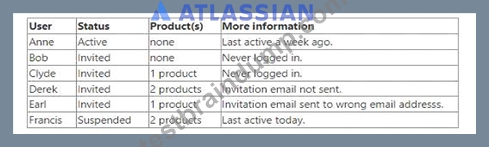
How many of these users are considered billable?
- A. 1 user
- B. 2 users
- C. 5 users
- D. 3 users
- E. 4 users
- F. 6 users
Answer: C
Explanation:
Explanation
Users who have access to at least one product are considered billable. In this case, Clyde, Derek, Earl, Francis, and Anne are billable users. Bob is not billable because he has not accepted the invitation to join the organization.
References = [Manage users and user tiers] and [Control how users get access to products]
NEW QUESTION # 42
Bob only needs to update project schemes in your Jira site.
He should not have too much access or use a license if it is not necessary.
Which product access configuration is correct?
- A. Option A
- B. Option C
- C. Option D
- D. Option B
Answer: C
Explanation:
Explanation
The correct product access configuration for Bob is Jira Administration with Product admin role and Jira Software with User role. This will allow Bob to update project schemes in Jira Software, as well as other project settings, without using a license. The Product admin role for Jira Administration grants access to the Jira Administration product, which is aseparate product from Jira Software that does not consume a license. The User role for Jira Software grants access to the Jira Software product, which does consume a license, but is necessary for Bob to view and edit project schemes12 References = Manage product access, Jira Administration overview
NEW QUESTION # 43
You need strict control over the number of active licenses for Jira Software.
What can you do to gain stricter control?
- A. Remove all groups from all Jira Software product roles.
- B. Remove the default group from the Jira Software User product role.
- C. Disable anonymous users in Jira and Confluence.
- D. Remove the User product role itself for Jira Software.
- E. Require admin approval for all approved domains.
Answer: B
Explanation:
Explanation
By removing the default group from the Jira Software User product role, you can prevent new users from automatically getting access to Jira Software when they join your site. This way, you can control who gets access to Jira Software and how many licenses are consumed.
ReferencesManage product access Product roles and permissions
NEW QUESTION # 44
You want to delete a group that is currently used throughout Jira.
Where is the group definitely NOT used?
- A. to limit who can make bulk updates
- B. to restrict who can invite teammates to Jira
- C. to search using the membersOf("") function
- D. to hide workflow transitions
- E. to secure the visibility of certain issues
Answer: B
Explanation:
Explanation
The statement that is true is that the group is definitely not used to restrict who can invite teammates to Jira.
This is because inviting teammates to Jira is a site administration function that is controlled by the site admin role, not by any group. The other statements are false, as the group could be used for those purposes, depending on how the group is configured in the global permissions, the permission schemes, the issue security schemes, or the workflow conditions.
NEW QUESTION # 45
A Cloud organization has two sites and products as shown.
Which statement is definitely true?
- A. Both sites have the same product admins.
- B. Both sites are on the same pricing plan for Jira Software.
- C. Both sites have the same default groups.
- D. Both sites have the same org admins.
- E. Both sites have the same users for Jira Software.
Answer: D
NEW QUESTION # 46
Ahmed, a new org admin, made a change to organization settings that caused a problem in Jira Software.
When users respond to notifications, the replies are no longer being sent to "[email protected]" but instead to "[email protected]".
What change did Ahmed make?
- A. changed Jira Software product access
- B. removed an approved domain
- C. removed an email domain
- D. updated the Jira Software product URL
- E. removed a Jira product admin
Answer: D
Explanation:
Explanation
Updating the product URL changes the email address from which notifications are sent and received. Ahmed should have configured the sender email address for the Jira Software project to use the custom email address
"[email protected]".
References: Configure email notifications, Update a product URL to a new URL
NEW QUESTION # 47
You went to the pricing page for one of the Cloud products and started a site with a Premium subscription trial to that product.
You used your work email address, "[email protected]".
What was definitely created?
- A. sandbox
- B. "malamute.edu" approved domain
- C. Preview track
- D. Jira Administration product
- E. "site-admins" group
Answer: E
Explanation:
Explanation
When you start a site with a Premium subscription trial to a Cloud product, you automatically create a
"site-admins" group that contains your account as the only member. The "site-admins" group has the site admin role, which allows you to manage the site settings, products, users, and groups. You can also add other users to the "site-admins" group if you want to delegate some of the site administration tasks.
References = Create and update groups and Manage site-level permissions
NEW QUESTION # 48
Your Cloud organization has the following:
. 2 production instances of Jira Software
. 2 production instances of Confluence
What else does your organization definitely have?
- A. at least 1 verified domain
- B. at least 2 sites
- C. at least 2 sandboxes
- D. at least 1 Premium subscription plan
- E. exactly 4 landing products
Answer: B
Explanation:
Explanation
An Atlassian Cloud organization can have one or more sites, each containing one instance of each product1. A site has its own URL and administration settings2. Since your organization has two instances of Jira Software and two instances of Confluence, it must have at least two sites to host them. For example, one site could have the URL acme.atlassian.net and contain Jira Software and Confluence, while another site could have the URL acme-dev.atlassian.net and contain another instance of Jira Software and Confluence.
The other options are not necessarily true for your organization. Having multiple sites does not imply that you have verified your domain, which is a process that allows you to manage the Atlassian accounts of your users and apply security policies to them3. You may or may not have verified your domain, depending on whether you have access to your domain's DNS or HTTPS settings. Verifying your domain is not required to use Atlassian cloud products.
A landing product is the product that your users see first when they log in to your site4. You can only set the landing product to Jira or Confluence. Therefore, you cannot have exactly four landing products, as you can only have one landing product per site. You may have two landing products if you set one for each site, or you may have none if you do not set any.
A Premium subscription plan is a plan that offers advanced features, unlimited storage, 99.9% uptime SLA, and 24/7 Premium support for Jira Software, Confluence, Jira Service Management, and Jira Work Management5. You may or may not have a Premium subscription plan for your products, depending on your needs and budget. Having multiple sites or products does not automatically mean that you have a Premium subscription plan.
A sandbox is an isolated environment where you can test and experiment before making changes to production6. A sandbox is available for Jira Software, Jira Service Management, and Confluence with Premium and Enterprise plans6. You may or may not have sandboxes for your products, depending on whether you have a Premium or Enterpriseplan and whether you have created a sandbox from your organization. Having multiple sites or products does not automatically mean that you have sandboxes.
References :
Understand Atlassian sites and organizations
What is an Atlassian organization?
Verify a domain to manage accounts
Set your site's landing product
Atlassian Cloud Premium
Manage product sandboxes
NEW QUESTION # 49
Alpha Corp. recently acquired one of its competitors, Beta Corp.
Each company had its own Atlassian Cloud organization.
You would like to manage users and groups from both corporations in a single location.
Identify the correct feature to use.
- A. Release tracks
- B. Transfer products
- C. Verify domains
- D. Identity providers
- E. Organization insights
Answer: B
Explanation:
Explanation
If you want to manage users and groups from both corporations in a single location, you need to consolidate your Atlassian Cloud organizations. This can be done by transferring all product instances in one organization to another. After the transfer, the unwanted organization is deleted1. This feature is called Transfer products and it is available from the organization settings2.
The other options are not features that can help you merge your organizations. Organization insights is a feature that provides analytics and reports on your organization's users, products, and security3. Release tracks is a feature that allows you to choose when your cloud products receive new features and improvements4. Verify domains is a feature that allows you to manage the Atlassian accounts of your users and apply security policies to them5. Identity providers is a feature that allows you to integrate your organization with external identity services, such as SAML or SCIM6.
References :
Should I merge my Atlassian organizations?
Transfer all products to another organization
View organization insights
Choose a release track for your cloud products
Verify a domain to manage accounts
Manage users from your identity provider
NEW QUESTION # 50
IT had written a script to return a list of domains in your Cloud organization.
That script is no longer needed and you would like to ensure the script can no longer access that information.
What should you do?
- A. delete IP allowlist
- B. remove DNS records
- C. remove a verified domain
- D. revoke API key
- E. regenerate security key
Answer: D
Explanation:
Explanation
If you want to ensure that the script can no longer access the information about the domains in your Cloud organization, you need to revoke the API key that was used to authenticate the script. An API key is a token that allows you to manage your organization via the admin APIs1. You can create, view, and revoke API keys from the organization settings2. Revoking an API key will invalidate it and prevent any further requests using that key2.
The other options are not relevant or effective for stopping the script from accessing the information.
Removing DNS records or removing a verified domain will not affect the API key that was used by the script. It will only affect the verification status of your domain and the management of your users and accounts3. Regenerating a security key will not affect the API key that was used by the script. It will only affect the encryption of your data at rest4. Deleting an IP allowlist will not affect the API key that was used by the script. It will only affect the IP addresses that are allowed to access your organization and products5.
References :
Manage an organization with the admin APIs
Create and revoke API keys
Verify a domain to manage accounts
Regenerate your security key
Set up an IP allowlist
NEW QUESTION # 51
......
Get Prepared for Your ACP-520 Exam With Actual 67 Questions: https://www.testbraindump.com/ACP-520-exam-prep.html
Valid ACP-520 Test Answers Full-length Practice Certification Exams: https://drive.google.com/open?id=1iz3bXIDDO43F4jKDO5F-avycI9toCTxH
