
Verified PMI-PBA Exam Dumps PDF [2024] Access using TestBraindump
Try Best PMI-PBA Exam Questions from Training Expert TestBraindump
NEW QUESTION # 103
The requirements baseline is ready for sign-off when the requirements are:
- A. clear, consistent, complete, and validated.
- B. complete, clear, verified, and adopted.
- C. justified, clear, consistent, and verified.
- D. consistent, analyzed, complete, and validated.
Answer: D
NEW QUESTION # 104
In the first few weeks after a large implementation of a new web-based application, a critical report failed.
Further investigation determined that a worker had been using a field that was not supposed to be used.
This issue was not identified in testing.
Which technique could have prevented this problem from occurring?
- A. Use cases
- B. Diagrams
- C. Prototyping
- D. Document analysis
Answer: A
NEW QUESTION # 105
A business analyst has received a test result report that shows evidence of defective functionality. The business analyst checks the test result again and verifies that the functionality behaves according to the requirements.
At this point, the business analyst should first:
- A. let the users decide if the test result is acceptable.
- B. ask the tester to perform the test again.
- C. verify that the test case is incorrect.
- D. change the requirement according to the test result.
Answer: C
NEW QUESTION # 106 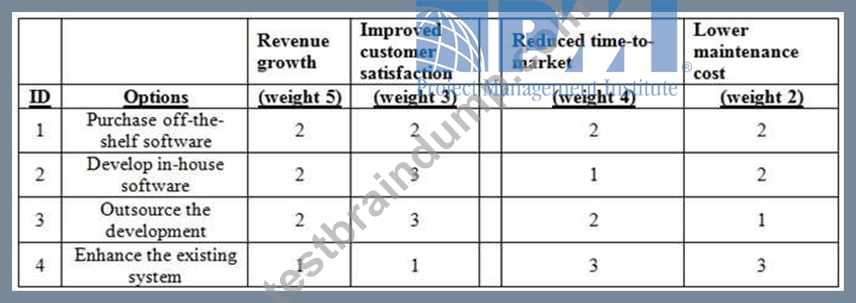
Which solution should be chosen according to the completed weighted-ranking matrix?
- A. Enhance the existing system.
- B. Outsource the development.
- C. Purchase off-the-shelf software.
- D. Develop in-house software.
Answer: D
NEW QUESTION # 107
After reviewing a business case, project goals, and objectives, a business analyst determines that the organization prefers taking an exploratory approach to finding the solution that best meets the business need. Which approach best aligns with the business need for this organization?
- A. Plan-driven approach
- B. Analytical approach
- C. Change-driven approach
- D. Waterfall approach
Answer: C
Explanation:
Explanation/Reference: https://www.slideshare.net/carlitos5071989/babok-v20
NEW QUESTION # 108
A business analyst has started a project for a system enhancement. In order to determine how the requirements will be approved, the business analyst schedules a meeting with the stakeholders to discuss the proposed approval process.
Which measure of effective decision making allows the business analyst to finalize the process for requirement approval?
- A. The requirements approval process is documented.
- B. The requirements elicitation process is documented.
- C. The requirements verification process is documented.
- D. The requirements validation process is documented.
Answer: A
Explanation:
Explanation
The requirements approval process is documented as a measure of effective decision making that allows the business analyst to finalize the process for requirement approval. The requirements approval process defines the roles, responsibilities, criteria, methods, and tools for approving the requirements and ensuring that they meet the stakeholder needs and expectations. The requirements approval process should be agreed upon by the stakeholders and the business analyst before the requirements are elicited, analyzed, and validated. The requirements verification process is not a measure of effective decision making, but a technique for ensuring that the requirements are complete, correct, consistent, and clear. The requirements elicitation process is not a measure of effective decision making, but a set of activities for discovering, gathering, and understanding the stakeholder needs and expectations. The requirements validation process is not a measure of effective decision making, but a technique for confirming that the requirements align with the business objectives and deliver value to the stakeholders. References: Business Analysis for Practitioners: A Practice Guide, page 113-114 1; PMI Professional in Business Analysis (PMI-PBA)
Examination Content Outline, page 17 2.
NEW QUESTION # 109
When a business analyst uses subject matter experts to define roles and identify influencers, which project artifact is created or updated?
- A. Stakeholder register
- B. Stakeholder management plan
- C. RACI matrix
- D. SWOT analysis
Answer: A
Explanation:
Explanation/Reference: https://cs.anu.edu.au/courses/comp3120/public_docs/BOKV1_6.pdf
NEW QUESTION # 110
What is a standardized, effective, and efficient way to manage changes to project documentation?
- A. A configuration management system
- B. A change control board
- C. A requirements traceability matrix
- D. A configuration verification and audit system
Answer: A
Explanation:
Explanation
A configuration management system is a standardized, effective, and efficient way to manage changes to project documentation. A configuration management system is a set of tools and processes that help to track, control, and update the configuration items (CIs) of a project, such as documents, requirements, designs, code, tests, etc. A configuration management system helps to ensure that the project documentation is consistent, accurate, and up-to-date throughout the project life cycle. It also helps to maintain the traceability and auditability of the changes made to the project documentation. A configuration management system typically includes the following components:
A configuration management plan that defines the scope, roles, responsibilities, policies, procedures, and standards for configuration management.
A configuration management database (CMDB) that stores the information about the CIs, their attributes, relationships, versions, baselines, and changes.
A configuration identification process that assigns unique identifiers and names to the CIs and their versions.
A configuration control process that evaluates, approves, and implements changes to the CIs and their versions.
A configuration status accounting process that records and reports the status and history of the CIs and their versions.
A configuration verification and audit process that verifies and validates the CIs and their versions against the requirements and specifications.
References: = PMI Professional in Business Analysis (PMI-PBA)
Examination Content Outline, page 13.
NEW QUESTION # 111
What should the business analyst do to ensure that all requirements meet a quality checklist before the development and testing phase?
- A. Negotiate with the client to standardize the requirements.
- B. Assign a verification method to each requirement.
- C. Obtain approval from engineering for partial testing of the requirements.
- D. Validate the requirements deemed important by the stakeholders.
Answer: D
NEW QUESTION # 112
A business analyst has captured all of the requirements from the various stakeholders within the organization and has compiled them into a complete list. After reviewing the list of requirements with the stakeholders, it is determined that the list of requirements is too large and will exceed the allotted budget.
Which tool or technique should the business analyst use with the stakeholders to prioritize the requirements to determine which requirements are approved, deferred, or rejected?
- A. MoSCoW Analysis
- B. SWOT Analysis
- C. SMART Goals
- D. Timeboxing Analysis
Answer: A
NEW QUESTION # 113
Company A has set aside capital to invest in an upgrade to their scheduling system. Documentation of the current structure was presented to the business analyst. However, the description of certain steps is not documented clearly, and the business analyst has not been allowed to inspect the existing system. During elicitation, the business analyst asked questions of the schedulers as they performed functions in order to gain an understanding of the process.
Which type of elicitation technique did the business analyst use in this instance?
- A. Active observation
- B. Simulation
- C. Participatory observation
- D. Interview
Answer: A
Explanation:
Explanation
Active observation is an elicitation technique that involves observing the work performed by stakeholders in their own environment and asking questions to clarify or confirm the understanding of the process. Active observation allows the business analyst to gain insights into the current state, identify gaps or issues, and discover undocumented or implicit requirements. Active observation is different from participatory observation, which involves performing the work alongside the stakeholders, and from interview, which involves asking structured or unstructured questions to elicit information from stakeholders. Simulation is an elicitation technique that involves creating a model or a prototype of the solution or a part of it and using it to elicit feedback from stakeholders. References: PMI Professional in Business Analysis (PMI-PBA) Examination Content Outline1, page 10; Business Analysis for Practitioners: A Practice Guide2, page 62.
NEW QUESTION # 114
When managing a product backlog, which statement best describes how to determine the value of backlog items?
- A. The stakeholders provide input about backlog value when the item is first identified.
- B. The stakeholders provide recommendations with the product owner having the final say.
- C. The stakeholders follow the value-ranking criteria.
- D. The stakeholders do not typically play a major role.
Answer: C
Explanation:
Explanation/Reference: https://www.scrum.org/resources/blog/10-tips-product-owners-business-value
NEW QUESTION # 115
A company is developing a new product for a customer and is required to verify and validate the product against the customer's acceptance test plan and requirements. The product was successfully verified against the acceptance test criteria, but the customer does not believe that the product meets the requirements.
This occurred because the customer's acceptance test plan:
- A. was not included in the work breakdown structure.
- B. did not have measurable and testable requirements.
- C. was incomplete and missing requirements.
- D. was not formally accepted by the company.
Answer: D
Explanation:
Explanation/Reference:
NEW QUESTION # 116
A business analyst has been assigned to a project team that is redesigning the company's website The business analyst has been documenting the relationships between requirements and has found requirements that do not trace to a business need.
Which type of requirements are these?
- A. In-scope
- B. Out-of-scope
- C. Implemented
- D. Tested
Answer: B
NEW QUESTION # 117
Which of the following can be used to determine if requirements align to the product's objectives?
- A. Five Whys
- B. Business use cases
- C. Context diagrams
- D. Activity network diagrams
Answer: C
Explanation:
Explanation
Context diagrams are a technique that can be used to determine if requirements align to the product's objectives. Context diagrams are a technique that involves creating a visual representation of the product and its interactions with its environment, such as other systems, processes, or stakeholders. Context diagrams can help to define and clarify the scope, boundaries, and interfaces of the product. Context diagrams can also help to verify that the requirements are consistent and compatible with the product's objectives and value proposition. Five Whys is not a technique that can be used to determine if requirements align to the product's objectives. Five Whys is a technique that involves asking a series of why questions to identify the root cause of a problem or an effect. Five Whys can help to understand and resolve the underlying issues or needs that drive the requirements, but it does not directly compare or evaluate the requirements against the product's objectives. Activity network diagrams are not a technique that can be used to determine if requirements align to the product's objectives. Activity network diagrams are a tool that involves creating a graphical representation of the sequence and dependencies of the activities or tasks in a project or a process. Activity network diagrams can help to plan and manage the schedule, resources, and risks of a project or a process, but they do not depict or assess the requirements or the product's objectives. Business use cases are not a technique that can be used to determine if requirements align to the product's objectives. Business use cases are a tool that involves describing and documenting how a stakeholder interacts with a system or a solution to achieve a specific goal or outcome. Business use cases can help to specify and communicate the functionality and behavior of a system or a solution, but they do not measure or validate the requirements or the product's objectives. References: Business Analysis for Practitioners: A Practice Guide 1, page 78-79; PMI Professional in Business Analysis (PMI-PBA)
Examination Content Outline 2, page 16.
NEW QUESTION # 118
During a requirements workshop, sponsors and managers from different departments express varying points of view and priorities about the product's functions and requirements. The business analyst struggles with facilitating the group to reach an agreement.
What should the business analyst have defined to avoid this?
- A. Decision-making process in the business analysis plan
- B. Communications approach in the project management plan
- C. Decision-making process in the project management plan
- D. Communications approach in the business analysis plan
Answer: A
Explanation:
Explanation
The decision-making process in the business analysis plan defines how decisions will be made regarding the requirements and the business analysis approach. It specifies the roles and responsibilities of the decision makers, the criteria and methods for making decisions, and the process for resolving conflicts and disagreements. Having a clear decision-making process can help the business analyst facilitate the requirements workshop and reach an agreement among the stakeholders with different points of view and priorities. References: = PMI Professional in Business Analysis (PMI-PBA)
Examination Content Outline,
page 13.
NEW QUESTION # 119
The business analyst has been assigned to a project which delivers functionality for a much larger solution. The project has many requirements but has not received adequate funding. In addition, the stakeholders' views conflict.
Which tools and techniques should the business analyst use to maximize business value while establishing the requirements baseline?
- A. Traceability matrix, context diagrams, and scope document.
- B. Decision trees, weighted matrix, and context diagrams.
- C. Weighted matrix, process flow, and organizational chart
- D. Stakeholder register, decision tree, and capability matrix
Answer: C
NEW QUESTION # 120
A business analyst is leading a project to implement automated order entry software at a local pizza restaurant.
The business analyst has very little information about the project the ordering process takes too long and often ends in incorrect orders.
What step should the business analyst take next?
- A. Request information on the current ordering process and compare it with other companies.
- B. Schedule a requirements gathering sessions with the manager of the ordering department.
- C. Select the software to implement and start working with the technical resources.
- D. Identify testing resources to support the implementation.
Answer: A
NEW QUESTION # 121
Which of the following is an example of a functional requirement?
- A. The system is able to require passwords.
- B. The system can be accessed from multiple locations.
- C. The system provides an user-friendly interface.
- D. The system can handle 3.000 user requests concurrently.
Answer: B
NEW QUESTION # 122
Whjch tool provides combined functionality for business analysis and quality assurance activities?
- A. System use case modeling tool
- B. Functional specification tool
- C. Requirements traceability tool
- D. Solution quality assurance tool
Answer: B
NEW QUESTION # 123
A business analyst is working on a project to implement a new call management system for a help desk.
They expected the average time interval to answer a call to decrease over time, but the interval has increased instead.
Which technique should the business analyst use to investigate the problem?
- A. Interviews
- B. Root cause analysis
- C. Observation
- D. Process modeling
Answer: B
NEW QUESTION # 124
The business analysts have concluded a requirements elicitation workshop. They now need to define rationale for each requirement. Which of the following pairs of items would be important to include in the rationale?
- A. Functional relationships and work breakdown structure code
- B. Reasons and assumptions
- C. Product vision and operational relationships
- D. Stakeholder impact and design decisions
Answer: B
NEW QUESTION # 125
An organization is evaluating the possibility of conducting business internationally. Which factors should be investigated at the onset of the initiative?
- A. External dependencies
- B. Change control processes
- C. Deliverables to be produced
- D. Impacts on requirements baseline
Answer: D
NEW QUESTION # 126
The project team has all the document control process and versioning in place to capture the requirements changes. The team ensures that the change is documented in the scope document, resulting in the changed work breakdown schedule (WBS) and schedule. However, a key requirement was not implemented in the release.
Which is a possible reason why the requirement was not implemented?
- A. The requirements traceability matrix was not updated with the change.
- B. The schedule management plan was not updated with the change.
- C. The scope management plan was not updated with the change.
- D. The requirements management plan was not updated with the change.
Answer: A
Explanation:
Explanation
A requirements traceability matrix is a tool that links the requirements to their sources, objectives, and deliverables. It helps to track the status, changes, and verification of each requirement throughout the project life cycle. If the requirements traceability matrix was not updated with the change, it could result in a key requirement being missed or overlooked in the implementation. The other options are not likely to cause this problem. The requirements management plan is a document that describes how the requirements will be elicited, analyzed, documented, validated, and managed. The scope management plan is a document that describes how the project scope will be defined, controlled, and verified. The schedule management plan is a document that describes how the project schedule will be developed, monitored, and controlled. References:
PMI-PBA
Examination Content Outline, page 13; PMI-PBA
Reference List, page 1, BABOK
Guide v3,
page 39; 6.
NEW QUESTION # 127
......
Latest 100% Passing Guarantee - Brilliant PMI-PBA Exam Questions PDF: https://www.testbraindump.com/PMI-PBA-exam-prep.html
Practice Examples and Dumps & Tips for 2024 Latest PMI-PBA Valid Tests Dumps: https://drive.google.com/open?id=1n6ETpGwRiHFos8hzZ22eFUyHPredy7BK
