
Real NSK101 dumps Accurate Questions and Answers with Free and Fast Updates
Real NSK101 Quesions Pass Certification Exams Easily
NEW QUESTION # 23
You want to determine which NewEdge data planes that your remote users have been recently using.
Which area of the Netskope Tenant UI would provide this information?
- A. Users page under Settings
- B. Network Steering under Digital Experience Management
- C. Devices page under Settings
- D. Client Steering under Digital Experience Management
Answer: D
Explanation:
NewEdge Data Planes Monitoring:
* To determine which NewEdge data planes your remote users have been using, you need to access the relevant monitoring section in the Netskope Tenant UI.
Client Steering under Digital Experience Management:
* The Client Steering section under Digital Experience Management provides detailed information on how traffic is being steered for remote users.
* This section includes insights into the NewEdge data planes being utilized by users.
Steps:
* Navigate to Digital Experience Management in the Netskope Tenant UI.
* Select Client Steering to view detailed reports and logs on traffic steering.
* Analyze the data to identify the NewEdge data planes used by remote users recently.
References:
* For more details on accessing and using the Client Steering section under Digital Experience Management, refer to the Netskope documentation on digital experience management and client steering.
NEW QUESTION # 24
What are two supported ways to provision users to your customer's Netskope tenant? (Choose two.)
- A. Use the AD Connector.
- B. Use the Directory Importer.
- C. Use SCIM.
- D. Use Microsoft Intune.
Answer: A,C
Explanation:
* AD Connector:
The AD Connector is used to integrate your Netskope tenant with Active Directory (AD) to provision and synchronize user accounts.
It ensures that user information in Netskope is always up-to-date by periodically synchronizing with AD.
To set up the AD Connector:
Navigate to Settings > Tools > Directory Importer.
Configure the AD Connector with your AD details.
Set the synchronization schedule.
This method is commonly used in enterprise environments where AD is the primary user directory.
* SCIM (System for Cross-domain Identity Management):
SCIM is an open standard for automating the exchange of user identity information between identity domains or IT systems.
Netskope supports SCIM for provisioning users from identity providers like Okta, Azure AD, and others.
To configure SCIM:
Go to Settings > Tools > SCIM.
Follow the instructions to set up SCIM with your identity provider.
SCIM is beneficial for environments using modern identity management solutions.
* Reference:
For detailed configuration steps and additional information, refer to the Netskope documentation on provisioning users using the AD Connector and SCIM.
NEW QUESTION # 25
What is the limitation of using a legacy proxy compared to Netskope's solution?
- A. Netskope architecture requires on-premises components.
- B. Legacy on-premises solutions fail to provide protection for traffic from on-premises users.
- C. To enforce policies, traffic needs to traverse back through a customer's on-premises security stack.
- D. Legacy solutions offer higher performance and scalability for corporate and remote users.
Answer: C
Explanation:
A limitation of using a legacy proxy compared to Netskope's solution is that to enforce policies, traffic needs to traverse back through a customer's on-premises security stack. This creates latency, bandwidth, and scalability issues for remote users and cloud applications. Netskope's solution, on the other hand, leverages a cloud-native architecture that provides high-performance and scalable inspection of traffic from any location and device. References: [Netskope Architecture Overview]
NEW QUESTION # 26
Click the Exhibit button.
Referring to the exhibit, which statement accurately describes the difference between Source IP (Egress) and Source IP (User) address?
- A. You must always leave the source IP fields blank and configure the user identity as a source criteria.
- B. Source IP (Egress) is the IP address assigned to the endpoint host IP address while Source IP (User) is the public IP address of your Internet edge router.
- C. Source IP (Egress) is the public IP address of your Internet edge router while Source IP (User) is the address assigned to the endpoint.
- D. Source IP (Egress) is the IP address of the destination Web server while Source IP (User) is the IP address assigned to your network.
Answer: C
Explanation:
The statement that accurately describes the difference between Source IP (Egress) and Source IP (User) address is: Source IP (Egress) is the public IP address of your Internet edge router while Source IP (User) is the address assigned to the endpoint. Source IP (Egress) is the IP address that is visible to external networks when you send traffic from your network to the Internet. It is usually the IP address of your Internet edge router or gateway that performs NAT (Network Address Translation). Source IP (User) is the IP address that is assigned to your endpoint device, such as a laptop or a smartphone, within your network. It is usually a private IP address that is not routable on the Internet. You can use these two criteria to filter traffic based on where it originates from within your network or outside your network. References: Source Address / Source Port vs Destination Address / Destination PortHow to explain Source IP Address, Destination IP Address & Service in easy way
NEW QUESTION # 27
You want to use an out-of-band API connection into your sanctioned Microsoft 365 OneDrive for Business application to find sensitive content, enforce near real-time policy controls, and quarantine malware.
In this scenario, which primary function in the Netskope platform would you use to connect your application to Netskope?
- A. laaS API-enabled Protection
- B. Risk Insights
- C. DLP forensics
- D. SaaS API-enabled Protection
Answer: D
Explanation:
SaaS API-enabled Protection is a primary function in the Netskope platform that allows customers to connect their sanctioned SaaS applications to Netskope using out-of-band API connections. This enables customers to find sensitive content, enforce near real-time policy controls, and quarantine malware in their SaaS applications without affecting user experience or performance. If you want to use an out-of-band API connection into your sanctioned Microsoft 365 OneDrive for Business application to achieve these goals, you should use SaaS API-enabled Protection as the primary function in the Netskope platform. DLP forensics, Risk Insights, and IaaS API-enabled Protection are not primary functions in the Netskope platform that can be used to connect your application to Netskope. References: [Netskope SaaS API-enabled Protection].
NEW QUESTION # 28
You are required to create a policy that will notify and allow users to log into their personal Google Drive instance.
Which two policy components must be configured to enforce this use case? (Choose two.)
- A. User Constraint Profile
- B. User Alert
- C. Steering Exception
- D. Storage Constraint Profile
Answer: B,C
Explanation:
To create a policy that will notify and allow users to log into their personal Google Drive instance, you need to configure the following components:
* Steering Exception:
* This component allows you to create exceptions for specific traffic. In this case, you will configure a steering exception to allow traffic to personal Google Drive instances. This ensures that the policy correctly routes the traffic to the appropriate destination without being blocked or filtered incorrectly.
* User Alert:
* A User Alert component will be configured to notify users when they attempt to log into their personal Google Drive. This alert can provide information about the policy and any actions the user may need to take. It helps in enforcing the policy by informing users about the specific conditions or restrictions.
References:
* Netskope Knowledge Portal: Configuring Steering Exceptions
* Netskope Knowledge Portal: Creating User Alerts
NEW QUESTION # 29
You want to deploy Netskope's zero trust network access (ZTNA) solution, NPA. In this scenario, which action would you perform to accomplish this task?
- A. Create an OAuth identity access control between your users and your applications.
- B. Enable Steer all Private Apps in your existing steering configuration(s) from the admin console.
- C. Configure SCIM to exchange identity information and attributes with your applications.
- D. Set up a reverse proxy using SAML and an identity provider.
Answer: B
Explanation:
To deploy Netskope's zero trust network access (ZTNA) solution, NPA, you need to enable Steer all Private Apps in your existing steering configuration(s) from the admin console. This will allow you to create private app profiles and assign them to your applications. NPA will then provide secure and granular access to your applications without exposing them to the internet or requiring VPNs. Reference: [Netskope Private Access (NPA) Deployment Guide]
NEW QUESTION # 30
As an administrator, you need to configure the Netskope Admin UI to be accessible by specific IP addresses and to display a custom message after the admin users have been authenticated.
Which two statements are correct in this scenario? (Choose two.)
- A. Add the specific IP addresses on the IP Allow List.
- B. Enable and set the User Notification Template to display the custom message.
- C. Configure and enable the Privacy Notice to display the custom message.
- D. Add the specific IP addresses on the Network Location.
Answer: A,B
Explanation:
* Add the specific IP addresses on the IP Allow List (A):To restrict access to the Netskope Admin UI
* to specific IP addresses, administrators need to add these IP addresses to the IP Allow List. This ensures that only connections from these specified IP addresses are allowed access to the Admin UI. This configuration is crucial for enhancing security by limiting access to trusted IP addresses only.
* Enable and set the User Notification Template to display the custom message (D):To display a custom message to admin users after they have authenticated, administrators need to enable and configure the User Notification Template. This template allows the customization of messages that are shown to users, including after login. This feature is useful for displaying privacy notices, welcome messages, or other important information to users upon successful authentication.
These steps are verified based on the configuration options available within the Netskope Admin UI settings.
For more detailed steps and configuration, you can refer to the respective sections in the Netskope documentation.
NEW QUESTION # 31
You are working with a large retail chain and have concerns about their customer dat a. You want to protect customer credit card data so that it is never exposed in transit or at rest. In this scenario, which regulatory compliance standard should be used to govern this data?
- A. ISO 27001
- B. SOC 3
- C. AES-256
- D. PCI-DSS
Answer: D
Explanation:
PCI-DSS stands for Payment Card Industry Data Security Standard, which is a set of security requirements for organizations that handle credit card data. It aims to protect cardholder data from unauthorized access, disclosure, or theft, both in transit and at rest. PCI-DSS covers various aspects of security, such as encryption, authentication, firewall, logging, monitoring, and incident response. If you are working with a large retail chain and have concerns about their customer data, you should use PCI-DSS as the regulatory compliance standard to govern this data. SOC 3, AES-256, and ISO 27001 are not specific to credit card data protection, although they may have some relevance to general security practices. Reference: [PCI-DSS], [SOC 3], [AES-256], [ISO 27001].
NEW QUESTION # 32
Click the Exhibit button.
What are two use cases where the parameter shown in the exhibit is required? (Choose two.)
- A. When you share Incident details about files detected in a DLP incident.
- B. When you share the JoC between a third-party security solution and the Threat Protection Profile.
- C. When you create a policy to prevent file transfer between a sanctioned Google Drive and personal Google Drive.
- D. When you create a policy to prevent binary files larger than 5 MB that are shared publicly on a sanctioned OneDrive.
Answer: C,D
Explanation:
The parameter shown in the exhibit (File Profile) is crucial in policies where file type, size, and other attributes need to be specified. Here are two use cases where this parameter is required:
* When you create a policy to prevent file transfer between a sanctioned Google Drive and personal Google Drive:
* Explanation: In this use case, the File Profile is used to define the types of files that are not allowed to be transferred between different Google Drive instances. By specifying the file types in the policy, administrators can ensure that sensitive corporate data is not transferred to personal accounts.
* Implementation: Create a new File Profile with the desired file types and apply this profile in the policy that governs the data transfer rules between sanctioned and personal Google Drive instances.
* When you create a policy to prevent binary files larger than 5 MB that are shared publicly on a sanctioned OneDrive:
* Explanation: This use case involves creating a policy that restricts the sharing of large binary files (e.g., executable files) on publicly accessible folders in OneDrive. The File Profile parameter allows defining the file size and type criteria.
* Implementation: Define a File Profile that specifies binary files and sets a size limit (e.g., 5 MB).
Apply this profile in the policy to prevent such files from being shared publicly.
References:
* REST API v2 Overview - Netskope Knowledge Portal
* Using the REST API v2 dataexport Iterator Endpoints - Netskope Knowledge Portal
* Using the REST API v2 UCI Impact Endpoints - Netskope Knowledge Portal
* netskopesdk PyPI
* Netskope Rest APIv2(OAS 3.1) - Postman Collection
NEW QUESTION # 33
Exhibit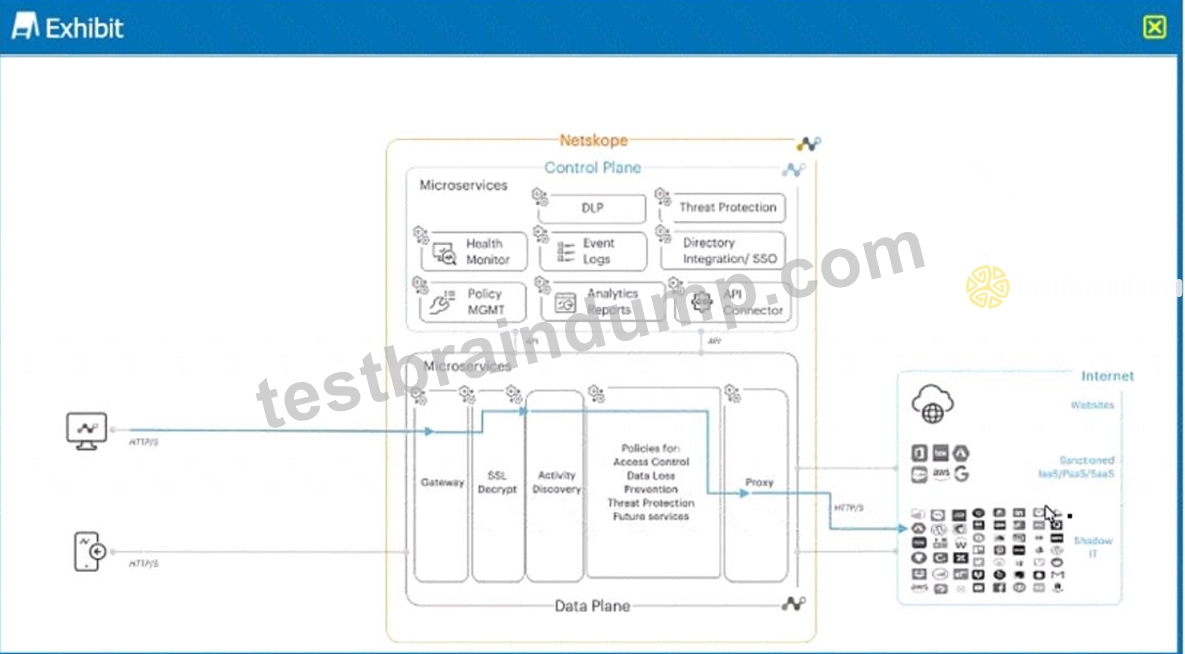
A user is connected to a cloud application through Netskope's proxy.
In this scenario, what information is available at Skope IT? (Choose three.)
- A. user activity, cloud app risk rating
- B. account instance, URL category
- C. username. device location
- D. file version, shared folder
- E. destination IP. OS patch version
Answer: A,B,C
Explanation:
In this scenario, a user is connected to a cloud application through Netskope's proxy, which is a deployment method that allows Netskope to intercept and inspect the traffic between the user and the cloud application in real time. In this case, Netskope can collect and display various information about the user and the cloud application at Skope IT, which is a feature in the Netskope platform that allows you to view and analyze all the activities performed by users on cloud applications. Some of the information that is available at Skope IT are: username, device location, account instance, URL category, user activity, and cloud app risk rating.
Username is the name or identifier of the user who is accessing the cloud application. Device location is the geographical location of the device that the user is using to access the cloud application. Account instance is the specific instance of the cloud application that the user is accessing, such as a personal or enterprise instance. URL category is the classification of the web page that the user is visiting within the cloud application, such as Business or Social Media. User activity is the action that the user is performing on the cloud application, such as Upload or Share. Cloud app risk rating is the score that Netskope assigns to the cloud application based on its security posture and compliance with best practices. Destination IP, OS patch version, file version, and shared folder are not information that is available at Skope IT in this scenario, as they are either unrelated or irrelevant to the proxy connection or the Skope IT feature. References: [Netskope Inline CASB], [Netskope Skope IT].
NEW QUESTION # 34
When comparing data in motion with data at rest, which statement is correct?
- A. Data at rest requires API integration.
- B. Data in motion requires API integration.
- C. Data in motion requires the Netskope client.
- D. Data at rest cannot be scanned for malware until a user opens the file.
Answer: A,C
Explanation:
When comparing data in motion with data at rest, the following statements are correct:
* Data in motion requires the Netskope client: To inspect and enforce policies on data as it is being transmitted across the network (data in motion), the Netskope client is required. The client steers the traffic through the Netskope cloud where it is analyzed and policies are applied in real-time.
* Data at rest requires API integration: To scan and enforce policies on data stored in cloud
* applications (data at rest), API integration is required. This allows Netskope to directly interact with cloud services and perform actions such as scanning for malware, applying DLP policies, and ensuring compliance.
References:
* Netskope documentation on data protection strategies, including data in motion and data at rest.
* Best practices for implementing API integrations for data at rest and using the Netskope client for data in motion.
NEW QUESTION # 35
All users are going through Netskope's Next Gen SWG. Your CISO requests a monthly report of all users who are accessing cloud applications with a "Low" or a "Poor" CCL, where the activity is either "Edit" or "Upload".
Using the Advanced Analytics interface, which two statements describe which actions must be performed in this scenario? (Choose two.)
- A. Create a report using the Data Collection "Page Events", filtering on the activities "Edit" and "Upload" for cloud apps with CCL values of "Low" or "Poor".
- B. Schedule a report with a monthly recurrence to be sent by e-mail with the attached PDF document at the end of each month.
- C. Schedule a report with a monthly recurrence to be sent by SMS with the attached PDF document at the end of each month.
- D. Create a report using the Data Collection "Application Events" filtering on the activities "Edit" and "Upload" for cloud apps with CCL values of "Low" or "Poor".
Answer: A,B
Explanation:
* Create the Report in Advanced Analytics:
Data Collection:
Use the "Page Events" data collection, which captures detailed user activities on web pages, including edits and uploads.
Filters:
Apply filters to include only the activities "Edit" and "Upload".
Add another filter for the Cloud Confidence Level (CCL) to include only those with "Low" or "Poor" ratings.
This ensures the report focuses on the specified user activities within cloud applications that have lower security ratings.
Steps:
Navigate to Advanced Analytics > Reports.
Create a new report and select "Page Events" as the data collection source.
Apply the necessary filters for activities and CCL values.
* Schedule the Report:
Monthly Recurrence:
Set the report to run on a monthly schedule to ensure regular updates.
Configure the report to be sent via email with a PDF attachment.
Steps:
In the report scheduling options, set the recurrence to monthly.
Specify the email recipients, ensuring the CISO receives the report.
Select PDF as the report format.
* Reference:
For more details on creating and scheduling reports, refer to the Netskope documentation on Advanced Analytics and report generation.
NEW QUESTION # 36
Which two use cases would be considered examples of Shadow IT within an organization? (Choose two.)
- A. an unsanctioned Microsoft 365 OneDrive account being used by a corporate user to upload sensitive data
- B. an unsanctioned Google Drive account used by a corporate user to upload non-sensitive data
- C. a sanctioned Wetransfer being used by a corporate user to share sensitive data
- D. a sanctioned Salesforce account used by a contractor to upload non-sensitive data
Answer: A,B
Explanation:
Shadow IT is the term for the unauthorized use of IT resources and functions by employees within an organization. It can include cloud services, software, and hardware that are not approved or managed by the IT department. Two use cases that would be considered examples of shadow IT within an organization are: an unsanctioned Microsoft 365 OneDrive account being used by a corporate user to upload sensitive data and an unsanctioned Google Drive account used by a corporate user to upload non-sensitive data. In both cases, the corporate user is using a personal cloud storage service that is not sanctioned by the organization to store work-related data. This can introduce security risks, such as data leakage, data loss, complianceviolations, malware infections, etc. The IT department may not have visibility or control over these cloud services or the data stored in them. References: What is shadow IT? | CloudflareWhat is Shadow IT? | IBM
NEW QUESTION # 37
What are two correct methods to gather logs from the Netskope Client? (Choose two.)
- A. Right-click on the Netskope task tray icon and click Save Logs...
- B. Open the Netskope Client application and click the Advanced Debugging button.
- C. From the Netskope Console in the device detail view, select Collect Log.
- D. Search for the systeminfo.log file in Explorer and submit the results.
Answer: A,C
Explanation:
From the Netskope Console in the device detail view, select Collect Log:
Step 1: Access the Netskope Admin Console.
Step 2: Navigate to the specific device detail view.
Step 3: Locate and select the "Collect Log" option.
Reference:
Right-click on the Netskope task tray icon and click Save Logs...:
Step 1: Go to the device running the Netskope Client.
Step 2: Locate the Netskope icon in the task tray.
Step 3: Right-click on the Netskope icon.
Step 4: Select "Save Logs..." from the context menu.
Netskope Knowledge Portal: Detailed guides on collecting logs via the Netskope Console and client applications.
NEW QUESTION # 38
You are working with traffic from applications with pinned certificates. In this scenario, which statement is correct?
- A. An exception should be added to the steering configuration.
- B. Traffic with pinned certificates should be blocked.
- C. The domains used by certificate-pinned applications should be added to the authentication bypass list.
- D. The domains used by applications with pinned certificates should be allowed in an inline policy.
Answer: A
Explanation:
When working with traffic from applications with pinned certificates, you should add an exception to the steering configuration to bypass them. Pinned certificates are a security technique that prevents man-in-the-middle attacks by validating the server certificates against a hardcoded list of certificates in the application. If you try to intercept or inspect the traffic from such applications, they will reject the connection or display an error message. Therefore, you should add the domains used by certificate-pinned applications as exceptions in your steering configuration, so that they are not steered to Netskope for analysis and enforcement. References: Certificate Pinned ApplicationsCreating a Steering Configuration
NEW QUESTION # 39
......
NSK101 Dumps are Available for Instant Access: https://www.testbraindump.com/NSK101-exam-prep.html
Practice with these NSK101 dumps Certification Sample Questions: https://drive.google.com/open?id=1z67P4dxGv54HnlmpK1B5kgWvr4iwB6zl
